Skip to content
Have you ever pulled a tarot card that felt oddly relevant to your situation? That’s synchronicity in action – a concept introduced by Carl Jung to describe “meaningful coincidences” that connect internal thoughts with external events. Tarot taps into this by reflecting your unconscious mind through archetypal symbols like The Fool or The Star.
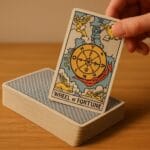
Here’s the key idea: Tarot cards don’t predict the future; they mirror your inner world. When cards align with your experiences, they highlight patterns and offer guidance. For example, seeing The Wheel of Fortune may suggest life’s cycles aligning, while The Tower might signal a sudden, transformative upheaval.
Jung’s theories explain how these connections emerge. By approaching tarot with intention and openness, you allow meaningful coincidences to surface. Whether it’s pulling the same cards repeatedly or noticing recurring symbols in daily life, synchronicity bridges intuition with external events, offering insight and clarity.
Want to explore this further? Start by setting a clear intention before a reading, journal your results, and observe how events align with your cards. Tarot becomes less about chance and more about uncovering meaning in the present moment.
Jungian Perspective on the Tarot by Ken James | Jung Platform
What Is Synchronicity in Tarot
Synchronicity highlights meaningful connections that go beyond simple cause-and-effect relationships. Swiss psychiatrist Carl Jung, who introduced the concept, described it as an "acausal connecting principle". Essentially, it’s when your inner world – your thoughts, emotions, or dreams – aligns with external events in ways that feel profoundly significant, even though there’s no direct link between the two.
In tarot, this concept shows up when the cards you draw seem to mirror your inner state. It’s not just chance at play; each card taps into deeper archetypal patterns stored in what Jung called the collective unconscious. Archetypes like the Fool, the Magician, or the High Priestess act as universal templates, helping you spot recurring themes and insights in your life.
This perspective challenges the Western tendency to rely solely on linear, cause-and-effect thinking. Joe Cambray, former president of the International Association for Analytical Psychology, explains it like this:
"Synchronicity… [is] an acausal connecting principle, whereby internal, psychological events are linked to external world events by meaningful coincidences rather than causal chains".
Carl Jung’s Theories on Synchronicity
Jung began developing his theory of synchronicity in the 1920s. He proposed that there’s a "psychoid layer" of reality where the boundaries between mind and matter blur, allowing archetypes to manifest both in your inner experiences and in the external world.
One of Jung’s most famous examples involved a patient who dreamt about receiving a golden scarab, a symbol of rebirth. During their session, a scarabaeid beetle – the closest equivalent in Europe – started tapping on Jung’s window. This uncanny coincidence broke through the patient’s rigid rationalism, paving the way for healing. It’s a striking parallel to how tarot cards can unexpectedly align with personal experiences.
Jung described such moments as examples of acausality, where connections are formed through meaning rather than direct cause-and-effect. This idea has even found support in therapeutic settings. A 2016 study revealed that 70% of therapists found synchronicity experiences to be helpful in therapy, and 44% said they had encountered such phenomena in their work.
Jung’s theories provide a framework for understanding how tarot readings channel synchronicity.
How Synchronicity Works in Tarot Readings
Jung’s ideas help explain how synchronicity unfolds during tarot readings. Your mindset and intentions play a key role in shaping the experience, allowing these meaningful coincidences to emerge. The cards act as "sacred mirrors", reflecting insights your unconscious mind already holds. Arthur Rosengarten, Ph.D., author of Tarot and Psychology, describes this process as one that reveals deeper truths.
To tap into synchronicity, it’s important to let go of overthinking. Jung warned that extreme rationalism – what he called "animus inflation" – can block access to the unconscious. Drawing cards with an open mind allows symbolic patterns to surface. The cards you pull aren’t random; they resonate with your current psychological state, revealing archetypal themes shaping your life.
As Jung once wrote:
"In all chaos there is a cosmos, in all disorder a secret order".
Interestingly, tarot’s appeal continues to grow. A 2025 Pew Research Center survey found that 11% of U.S. adults consult tarot cards at least once a year. These moments of synchronicity can feel transformative, offering clarity and guidance – even when they defy conventional logic.
Tarot Cards Associated with Synchronicity
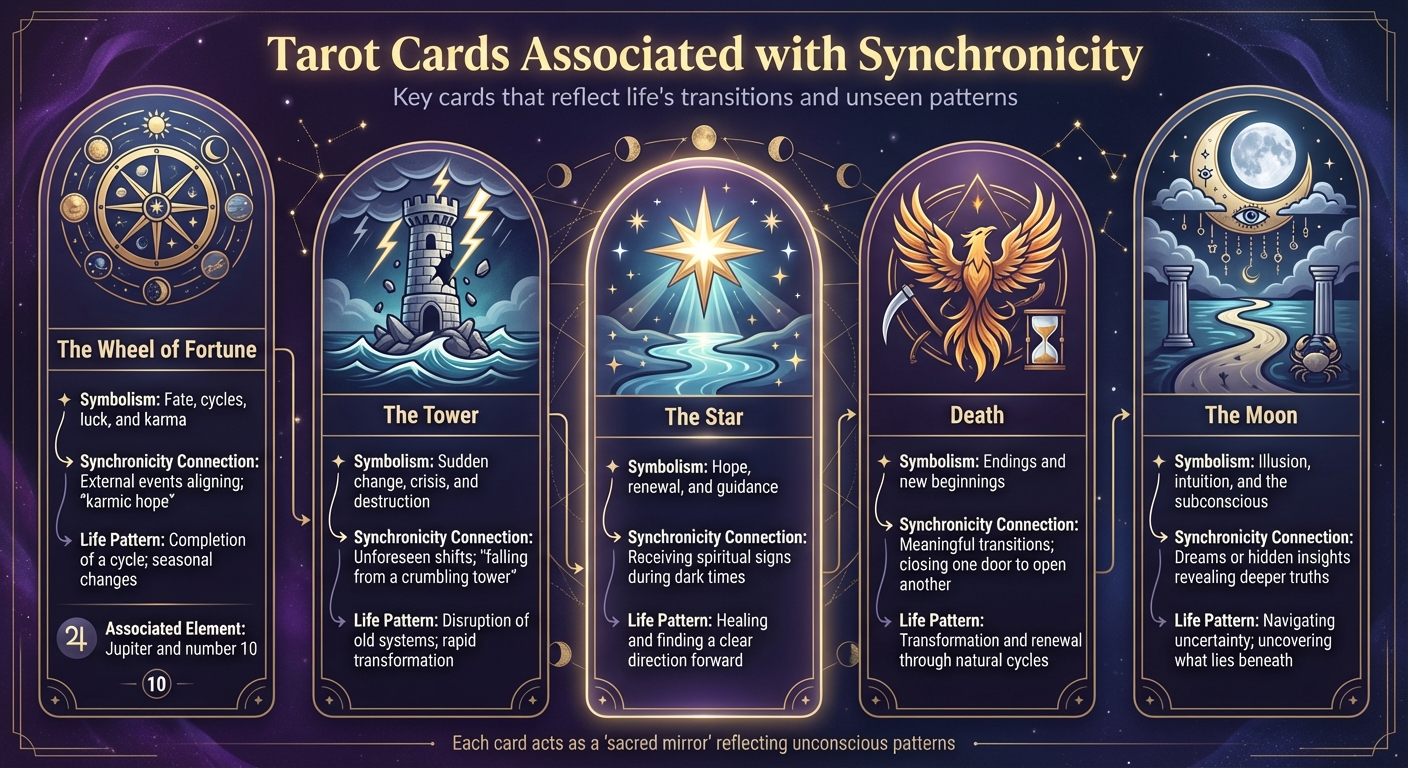
5 Major Tarot Cards Associated with Synchronicity and Their Meanings
Some tarot cards are deeply tied to synchronicity because their imagery and meanings reflect life’s transitions and unseen patterns. These cards tap into universal archetypes, signaling changes that align with the rhythms of life. By connecting the symbolism of these cards to synchronicity, we gain a richer perspective on how tarot readings can mirror our experiences. Below are the key cards often linked to synchronicity.
Key Synchronicity Cards
The Wheel of Fortune is often considered the ultimate card of synchronicity. Linked to Jupiter and the number 10, this card represents cycles completing and the arrival of karmic outcomes. When it appears, it suggests that external circumstances are aligning in your favor, hinting at the interconnectedness of events. Mark Patrick Hederman describes the Major Arcana as "visual aids to the unconscious", and the Wheel perfectly captures this idea, reminding us that life is always in motion.
The Tower represents sudden, unexpected changes that shake the foundation of your life. It’s a card of upheaval, signaling that old structures are collapsing to make room for transformation. If this card comes up during a reading, it often coincides with moments of significant disruption, encouraging growth through change.
The Star offers hope and spiritual guidance, especially during challenging times. This card often appears when you’re searching for clarity and begin noticing meaningful signs that reinforce you’re heading in the right direction.
Death and The Moon round out this group of synchronicity cards. Death signifies endings that lead to new beginnings, marking natural transitions in life. Meanwhile, The Moon symbolizes intuition, dreams, and the subconscious, reflecting the hidden layers of reality and guiding you through uncertainty.
Tarot Card Symbolism and Synchronicity Comparison
The table below summarizes the symbolism of these cards and their connections to synchronicity and life’s patterns.
| Card | Symbolism | Synchronicity Connection | Life Pattern |
|---|---|---|---|
| Wheel of Fortune | Fate, cycles, luck, and karma | External events aligning; "karmic hope" | Completion of a cycle; seasonal changes |
| The Tower | Sudden change, crisis, and destruction | Unforeseen shifts; "falling from a crumbling tower" | Disruption of old systems; rapid transformation |
| The Star | Hope, renewal, and guidance | Receiving spiritual signs during dark times | Healing and finding a clear direction forward |
| Death | Endings and new beginnings | Meaningful transitions; closing one door to open another | Transformation and renewal through natural cycles |
| The Moon | Illusion, intuition, and the subconscious | Dreams or hidden insights revealing deeper truths | Navigating uncertainty; uncovering what lies beneath |
sbb-itb-2720e80
How to Spot Synchronicities in Daily Life
Common Signs and Patterns
Synchronicities often show up when you’re paying attention to the little details in life. One of the most frequently reported signs is repeating number sequences – like 111, 222, or 11:11. You might notice these on clocks, license plates, or even receipts, and they tend to stand out in a way that feels meaningful.
Another way synchronicity appears is through unexpected interpersonal connections. Think about those moments when an old friend calls out of the blue, a song plays that perfectly matches your current thoughts, or you keep encountering the same animal repeatedly. These occurrences often feel more than coincidental. Similarly, experiences of perfect timing – like catching every green light when you’re running late or stepping inside just as the rain starts – can also carry a sense of deeper significance.
Pay close attention to links between your dreams and waking life. Sometimes, details from your dreams will show up in reality, offering important insights from your subconscious. Since most people forget the majority of their dreams – up to 95% to 99% – keeping a journal by your bedside can help you capture these fleeting moments and recognize patterns.
Staying Open and Aware
The more you tune into synchronicities, the more they seem to happen. Studies suggest that simply being more attentive to these signs can make them appear more frequently. A great way to start is by setting daily intentions. At the beginning of your day, take a moment to silently ask for guidance on something specific. Then, stay alert to how that guidance might manifest throughout the day.
You can also practice mindfulness in your everyday activities. When something catches your attention, pause for a moment and reflect on your thoughts and emotions. Sometimes, your body might give you clues – chills, goosebumps, or even a sinking feeling in your stomach can indicate whether a sign is a confirmation or a warning. Keeping a synchronicity journal is another helpful tool. Writing down even the smallest patterns can strengthen your intuition and reveal connections you might have overlooked.
"Synchronicity means staying fully open to what unfolds next." – Dain Dunston, Coach and Author
These habits can also prepare you to explore tools like tarot for interpreting synchronicities more deeply.
How to Use Tarot to Interpret Synchronicities
Steps for Connecting Tarot and Synchronicity
Bringing together your inner thoughts and the universe’s signs can deepen your tarot practice. Start by setting a clear intention before shuffling your deck. Take a few deep breaths, clear your mind, and focus on your question – whether it’s about understanding a recurring pattern or decoding a specific sign you’ve noticed. This intentional focus creates a stronger connection between your awareness and the meaningful coincidences around you.
When framing your question, steer clear of simple "yes or no" formats. Instead, opt for open-ended questions like, "What lesson is hidden in this coincidence?" or "Why has this opportunity appeared now?". Such questions invite a deeper dialogue with the cards rather than limiting the response to a fixed answer. As you reveal the cards, pay attention to your initial reactions to their colors, symbols, and how they interact. Often, these gut-level impressions carry the most profound insights.
Keep a tarot journal to track and recognize patterns in synchronicities. For example, Frank, the founder of Tarot Awakenings, documented his daily three-card draws over six years. During a significant period of personal growth, he pulled the same three-card sequence two days in a row – an incredibly rare occurrence that encouraged him to trust his intuition over logic. To start your own journal, jot down your question, the cards you drew, and your first interpretation. Revisit these notes weeks or months later to validate your intuition and uncover long-term patterns.
If a reading or synchronistic event feels unclear, you can draw a clarifying card to help make sense of the situation. This extra step can bring added focus to your insights and guide your next steps.
Using Tarot for Guidance and Clarity
To deepen your understanding of synchronicities, try using specific tarot spreads. Tarot acts as a mirror for your inner world, reflecting unconscious patterns and potential paths forward. For example, if you notice a synchronicity in your life – like repeatedly seeing the same animal or hearing a particular song – try a two-card spread. Pull one card to represent what happens if you follow the sign and another to show what happens if you don’t.
Author Dan Adair explored how intent could spark synchronicity. While walking with the clear expectation that the universe would send him a sign, he encountered three significant people in a row. Repeating the experiment the next day, he met three different friends in a similar way. This highlights how combining tarot with active awareness can amplify meaningful coincidences.
"By using synchronicity for guidance, confirmation, and validation, people’s lives become a dance of energy with the Universe, a give and take with their environment that fills their days with insight and zest." – The Power of Flow
After completing a reading, take a photo of the cards or jot down quick notes, and keep reflecting on the symbols throughout your day. This habit helps you notice when external events align with the cards you pulled, reinforcing the connection between your inner guidance and the world around you. As Carl Jung once said, "In all chaos there is a cosmos, in all disorder a secret order." Let this practice remind you that even the smallest moments can reflect the larger patterns of your life.
Conclusion
Tarot readings offer a fascinating way to uncover the connections between your inner world and the events around you. The cards act as mirrors, reflecting unconscious patterns and hidden motivations through a rich language of symbols and archetypes. By practicing tarot intentionally, you can sharpen your awareness of these connections and notice transformations that might otherwise go unnoticed.
This practice creates a bridge between intuition and logic, helping you find meaning in life’s seemingly random moments. As psychologist Arthur Rosengarten explains:
"synchronicity is a special case of ‘acausality’ that additionally produces in the observer some intimate, self-deepening, or spiritually-enhancing meaningfulness".
Engaging regularly with tarot sets the stage for synchronicity to emerge, aligning your conscious thoughts with deeper truths. It transforms the way you perceive everyday moments, turning them into guiding signals. Instead of viewing events as isolated occurrences, you begin to notice recurring themes, patterns, and messages woven into your experiences. Tarot becomes a tool for heightened awareness, helping you pause and recognize signs that hold personal meaning. Whether it’s pulling a single card each morning or journaling about a three-card spread, this practice deepens over time, evolving into an ongoing dialogue with the patterns of life.
It doesn’t take much to get started. Spending just a few minutes each day with your deck can shift how you see the world. As you track your readings and observe how external events align with the cards, you’ll develop a deeper understanding of your intuition. This isn’t about predicting the future – it’s about uncovering meaning in the present and using that insight to guide your growth.
Let tarot be your partner in self-discovery. The more you engage with the cards and remain open to synchronicities, the more your life begins to reflect what The Power of Flow describes:
"By using synchronicity for guidance, confirmation, and validation, people’s lives become a dance of energy with the Universe, a give and take with their environment that fills their days with insight and zest".
Trust the process, listen to your intuition, and pay attention to the patterns that emerge – they can guide your journey toward personal growth and deeper understanding.
FAQs
How can tarot help me understand the synchronicities in my life?
Tarot serves as an insightful way to interpret synchronicities – those meaningful coincidences that feel like whispers from the universe. By starting with a clear intention, you can use the cards to delve into patterns or signs, whether it’s recurring numbers, a song that keeps playing, or unexpected events. Approach the deck with focus, shuffle with care, and let your intuition guide you as you draw cards to better understand these moments.
For instance, pulling a Major Arcana card might point to a broader life theme connected to the synchronicity, while a Minor Arcana card can shed light on specific aspects like your thoughts, emotions, or actions. Keeping a journal of your readings alongside the synchronicities you notice can reveal recurring patterns, offering a deeper understanding of how tarot reflects the signs you encounter in your life.
For additional support, Intuitive Answers provides daily tarot readings that can enhance your practice and bring clarity to the synchronicities you experience.
How do archetypes connect tarot readings with synchronicity?
Archetypes are universal symbols that tap into shared human experiences and emotions. In tarot, each card embodies an archetype – like the Hero, the Mother, or the Shadow – that connects with the reader’s subconscious. These symbols serve as reflective tools, bringing hidden thoughts, emotions, or possible paths into focus.
Synchronicity comes into play when external events align in a meaningful way with these archetypes. For instance, drawing the Justice card and then frequently encountering the number 11:11 might feel like more than just chance. This kind of connection can create a sense of order and provide new insights into one’s life.
At Intuitive Answers, tarot readings are tailored to help you engage with these archetypal symbols and notice synchronicities in your everyday experiences. They offer a unique way to delve into self-discovery and foster personal growth.
How can I tell if a tarot reading reflects my inner thoughts or unconscious mind?
A tarot reading that taps into your unconscious often brings a subtle yet striking "aha" moment – something that feels deeply resonant, even if it defies logical explanation. This experience is closely tied to synchronicity, a term Carl Jung used to describe meaningful coincidences that align your inner thoughts with external events.
You might recognize this connection in a few ways:
- Intense emotional responses: Certain cards evoke emotions that feel unshakably true, even if you can’t quite put them into words.
- Recurring symbols or themes: Seeing the same numbers, symbols, or cards across different readings may signal your unconscious mind trying to communicate.
- Real-life synchronicities: Messages from your reading might appear in unexpected places – like a conversation, a headline, or a chance encounter.
To strengthen this connection, approach your tarot practice with intention, trust your intuition, and reflect on recurring patterns over time. Intuitive Answers provides personalized tarot readings designed to help you uncover these inner signals and interpret the messages your unconscious is sending.