Skip to content
Dreams often communicate through symbols and emotions, offering insights into your subconscious. Tarot cards can help translate these messages, providing clarity and actionable steps. Here are five tarot spreads designed to interpret your dreams:
- Dream Messages Spread: Focuses on the core message and practical advice from your dream.
- Dream Mirror Spread: Connects dream imagery to your emotions and daily life, revealing hidden influences.
- General Dream Interpretation Spread: A simple 3-card layout that identifies the theme, current relevance, and future guidance of your dream.
- Dream Symbols Spread: Analyzes specific symbols from your dream to uncover personal meanings and connections.
- Dream Core Analysis Spread: A deeper dive into the emotional and symbolic elements of your dream using a 9-card layout.
Each spread offers a structured approach to understanding your dreams, helping you align subconscious insights with your waking life. To enhance your interpretations, keep a dream journal and focus on the emotions tied to your dreams. These methods can transform abstract imagery into meaningful guidance.
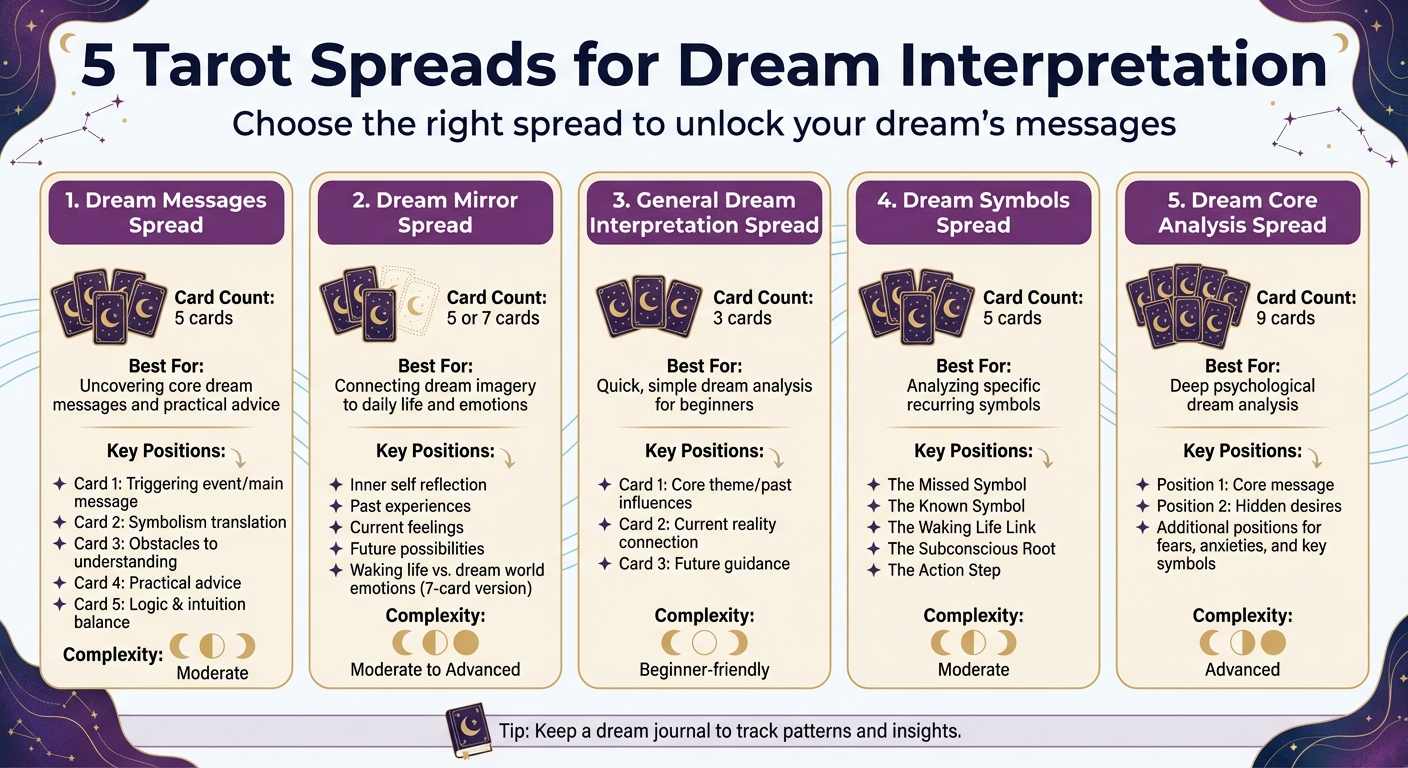
5 Tarot Spreads for Dream Interpretation Comparison Guide
Dream Interpretation with the Tarot and Dream Interpretation Tarot Spread
sbb-itb-2720e80
1. Dream Messages Spread
This spread helps uncover the deeper meaning behind your dreams. Using a five-card layout, it bridges the gap between dream symbolism and real-world understanding.
"This spread will focus on what is at the core of your dreams, and the message that it is trying to convey to you." – Labyrinthos
Each card in the spread plays a specific role in decoding your dream:
- Card 1: Highlights the triggering event or the main message of the dream.
- Card 2: Translates the dream’s symbolism into clearer insights.
- Card 3: Reveals obstacles that might be clouding your understanding.
- Card 4: Provides practical advice for addressing the message.
- Card 5: Balances logic and intuition to guide your next steps.
To get the most out of this spread, create an environment that encourages reflection. Lighting incense or sitting in a quiet, meditative space can help you connect deeply with the dream’s energy. As you shuffle the cards, focus on the emotions and sensations the dream evoked – these feelings often hold more meaning than the dream’s literal imagery.
Keep a journal to document both your dreams and the results of this spread. Pay special attention to recurring themes and the "Dreamer" card, which combines internal insights with actionable guidance. If you’re ready to dive even deeper, the next step is exploring the Dream Mirror Spread to uncover more layers of your subconscious.
2. Dream Mirror Spread
The Dream Mirror Spread connects the imagery of your dreams to your daily life, helping you uncover hidden influences. Christina Johnson, Founder of CenterSpirited, describes it as:
"It’s like holding up a mirror to your soul, showing how it reflects your subconscious identity."
This spread helps you understand how your dreams echo your emotions and experiences.
You can use either a 5-card or a 7-card layout, depending on the depth of insight you’re seeking. The 5-card version focuses on your inner self, past experiences, current feelings, and future possibilities, offering guidance on integrating your dream’s wisdom into your life. The 7-card version dives deeper, comparing emotions from your waking life and dream world, while also identifying obstacles that might be holding you back.
What makes this spread so powerful is its ability to highlight emotional gaps. Even if you feel in control during the day, your dreams might reveal hidden anxieties. By comparing "Waking Life Emotions" with "Dream World Emotions", you can uncover suppressed feelings. As Labyrinthos explains:
"Our waking lives are often intertwined with the dream world; don’t be surprised to find these spreads revealing hidden worries or preoccupations that you may have not addressed consciously."
Pay special attention to the "Waking Life Block" card in the 7-card layout. This card uncovers fears, limiting behaviors, or unresolved issues that might prevent you from fully embracing the message of your dream. When interpreting the spread, focus on the emotions you experienced in the dream rather than just the visual symbols – those feelings often hold the clearest insights into your waking life.
Before starting, find a quiet space to reflect on your dream and recall as many details as possible. Write down your interpretations right away to preserve fresh insights for later analysis. This practice transforms the symbols in your dreams into practical advice you can apply to your everyday life.
3. General Dream Interpretation Spread
The General Dream Interpretation Spread is a simple yet powerful way to uncover the deeper meaning behind your dreams. With just three cards, this layout translates the often mysterious symbols in your dreams into practical insights that connect to your life.
Christina Johnson, Founder of CenterSpirited, explains the connection between tarot and dreams beautifully:
"Tarot cards mirror the subconscious, reflecting the innermost thoughts, feelings, and experiences that often manifest in our dreams. This shared symbolic language allows tarot to act as a key to unlocking the messages our dreams convey, providing insights into our waking life challenges, aspirations, and spiritual journey."
This spread works by dividing your dream into three parts, with each card telling a different piece of the story:
- First card: Reveals the core theme of the dream or the past influences shaping it.
- Second card: Connects the dream to your current reality, uncovering emotions or challenges you’re facing now.
- Third card: Offers a glimpse into future possibilities, providing guidance on what steps to take next.
To get started, review your dream journal and focus on the emotions tied to the dream – whether it’s fear, joy, or confusion. Alex Getts, Author at IntSouls, highlights the importance of this emotional focus:
"The things you feel are as, if not more, important than the visuals you see."
Rather than overanalyzing every detail, center your attention on the feelings that stand out. Then, draw your three cards from left to right, and look for connections between them to uncover the message your subconscious is trying to share.
After the reading, match the "Current Reality" card with recent events to identify what might have triggered the dream. Use the "Future/Guidance" card to decide on one actionable step – whether it’s related to your relationships, career, or personal growth – that aligns your waking life with your dream’s insights. Keeping a record of these spreads alongside your dream journal can help you notice patterns and track how your understanding evolves over time.
4. Dream Symbols Spread
The Dream Symbols Spread hones in on recurring images from your dreams – like snakes, faces, or buildings – to provide interpretations that feel personal and relevant to your life. Instead of generic meanings from dream dictionaries, this method connects these symbols to your own unique experiences.
This spread focuses on uncovering the deeper messages behind individual symbols. Alex Getts, a writer at IntSouls, explains the importance of this approach:
"Symbols, words, and people’s environments are very personal, and there’s no one meaning that goes across every person."
The layout uses five cards to break down your chosen symbol:
- The Missed Symbol: Highlights details you might have overlooked.
- The Known Symbol: Validates your intuitive understanding of the image.
- The Waking Life Link: Connects the symbol to current challenges or situations.
- The Subconscious Root: Reveals underlying fears or desires tied to the symbol.
- The Action Step: Provides practical advice based on the interpretation.
For example, in April 2024, tarot practitioner Lisa Eddy worked with a vivid dream of an orange snake biting her left palm. Through a multi-card spread, she identified the snake with the King of Wands, interpreting it as a call to step into a leadership role.
To try this spread yourself, start by writing down the symbol that stood out most in your dream – focus on the emotions it stirred, not just what it looked like. If a card’s meaning feels unclear, draw a clarifying card and ask the symbol directly what it wants to reveal.
Keeping a personal symbol dictionary in your dream journal can also be a game-changer. Over time, you’ll notice patterns and gain a deeper understanding of how these images reflect your inner world. These insights can enrich your dream work and help you grow in self-awareness.
5. Dream Core Analysis Spread
The Dream Core Analysis Spread dives deep into your dream’s messages by breaking them down into emotional and symbolic elements using a nine-card layout. Unlike earlier spreads that offer broad insights, this one focuses on dissecting the psychological aspects of your dream.
Each card in the spread represents a specific psychological component. For example, Position 1 uncovers the core message of your dream, while Position 2 delves into hidden desires. Lisa Eddy sheds light on this second position:
"This card illuminates what you truly want, beyond societal expectations or self-imposed limitations. It might represent a longing for change, a secret ambition, or an emotional need you’ve been neglecting."
Other positions in the layout explore areas like fears, anxieties, and key symbols from your dream.
Before starting, take a moment to focus on the primary emotion you felt during the dream as you shuffle the cards. Alex Getts highlights the importance of this step:
"A clear focus on and access to the emotions of the dream will be a vital aspect of uncovering the best interpretation of the dream."
The emotional tone often holds more significance than the specific visuals you recall.
As you proceed, pay attention to the cards that appear – especially those from the Major Arcana. Major Arcana cards in the Core or Desire positions often point to major life lessons, while Minor Arcana cards, like Cups and Swords, highlight emotional or intellectual hurdles.
Be sure to document the Core Message and Hidden Desires cards to track recurring themes in your subconscious over time. If a card’s meaning feels unclear, you can draw a clarification card to deepen your understanding and strengthen the connection between your conscious mind and the symbols presented.
Conclusion
Dreams and tarot share a symbolic language that bridges the subconscious with conscious understanding. As Alex Getts puts it:
"A dream is a message from your subconscious mind, and Tarot is a tool to translate it."
The five spreads discussed here offer unique ways to interpret the messages hidden within your dreams. Unlike one-size-fits-all dream dictionaries, tarot provides insights that align with your personal journey, emotions, and surroundings. Whether you’re unraveling a recurring nightmare with the Dream Mirror Spread or delving into your hidden desires through the Dream Core Analysis Spread, these layouts turn dream imagery into meaningful, actionable advice.
There’s also a deep connection between vivid dreams and intuitive abilities. Practicing tarot can sharpen your dream clarity. To nurture this connection, try keeping a dream journal by your bed and setting intentions before sleep to enhance recall. Pay close attention to the emotions your dreams evoke, as these often reveal more than the visual symbols themselves.
For additional guidance, platforms like Intuitive Answers provide daily horoscopes, tarot readings, and resources on numerology, zodiac signs, and more. These tools can support your ongoing journey of self-awareness and spiritual exploration.
Your dreams hold wisdom, and tarot serves as the key to unlocking their messages, helping you turn abstract imagery into practical insights for your waking life.
FAQs
How can I pick the best tarot spread to interpret my dreams?
Choosing the right tarot spread for interpreting your dreams often depends on the kind of insight you’re after and the nature of the dream itself. If you’re looking for quick clarity, a three-card spread is a straightforward way to get an overview of your dream’s message. On the other hand, if you’re diving into complex symbols or seeking a deeper understanding, a five- or seven-card spread can provide more layers of meaning.
Think about what you’re hoping to uncover – whether it’s decoding hidden emotions, making sense of puzzling imagery, or uncovering the message your subconscious is trying to share. Trying out different spreads not only enhances your dream interpretations but also helps sharpen your intuition over time.
Can tarot help me understand recurring dreams or nightmares?
Tarot can be an insightful way to delve into recurring dreams or nightmares. With tarot spreads specifically designed for dream interpretation, you can begin to uncover the meanings behind the symbols and themes that appear in your dreams. These spreads act as a bridge to your subconscious, helping you explore unresolved emotions or fears that might be triggering these repeated or unsettling dreams.
Because dreams often speak through vivid imagery and strong emotions, tarot’s symbolic language pairs perfectly with dream analysis. By working with spreads tailored to this purpose, you can better understand the messages your subconscious is sending and take steps to address the underlying causes of recurring nightmares.
Should I focus more on dream symbols or emotions when interpreting dreams with tarot?
Dream symbols and emotions both play a role in interpreting dreams with tarot, but emotions often offer a deeper and more personal layer of understanding. The way you felt during the dream – whether it was fear, joy, or confusion – can provide clues about the messages your subconscious is trying to convey, sometimes beyond what symbols alone can reveal.
While symbols tend to reflect universal themes or archetypes, emotions tie directly to your unique experiences and inner life. By blending the two – recognizing the dream’s symbols and reflecting on the emotions it stirred – you can unlock a richer, more personal interpretation of the dream and its deeper meaning.