Skip to content
Tea leaf reading – also known as tasseography – has a rich history that spans thousands of years, evolving from ancient Chinese rituals to a popular social practice in Victorian parlors. This divination method interprets patterns left by tea leaves in a cup, offering insights into the future or personal reflection.
Here’s a quick overview of its journey:
- Origins in Ancient China: Began over 4,000 years ago as part of tea’s medicinal and spiritual use, influenced by Daoist philosophy.
- Spread Through Trade: Tea traveled along the Silk Road, carrying its traditions to Tibet, the Middle East, and Europe.
- Victorian Era Popularity: Became a household ritual in Britain and America, with specialized "fortune-telling cups" gaining traction.
- Modern Practice: Shifted focus from fortune-telling to introspection, blending spiritual and psychological approaches.
From its roots in Chinese tea culture to its modern-day revival among spiritual seekers, tea leaf reading continues to captivate those seeking meaning in everyday rituals.
History of Tea Leaf Reading: From Ancient China to Modern Practice
Origins in Ancient China
The Birth of Tea Culture
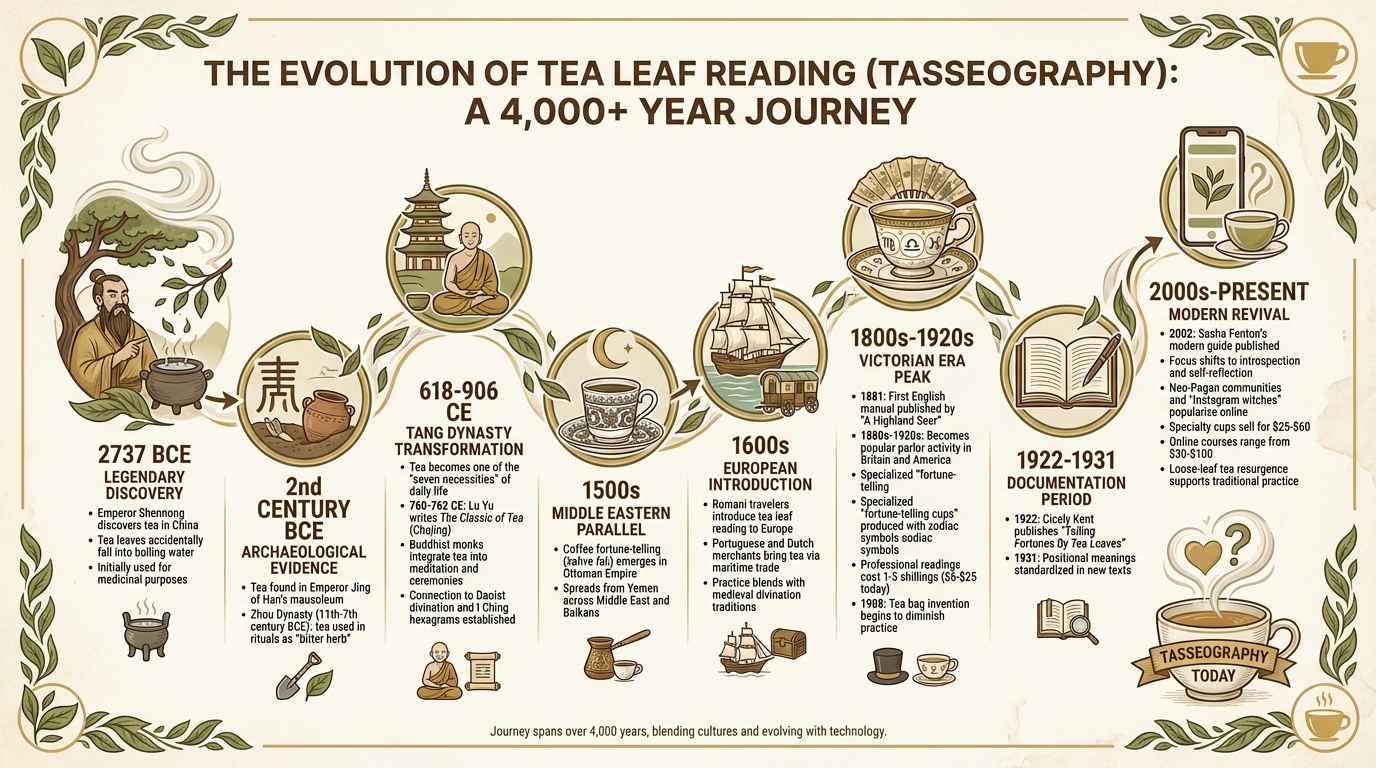
Tea’s journey began over 4,000 years ago in the Yunnan and Sichuan regions of Southwest China. According to legend, Emperor Shennong, a mythical figure, discovered tea in 2737 BC when leaves accidentally fell into his boiling water. The infusion, as the story goes, neutralized the 72 poisonous herbs he had consumed that day. For centuries after, tea was primarily used for medicinal purposes, often blended with herbs.
Archaeological evidence of tea’s early use was found in the mausoleum of Emperor Jing of Han, dating back to the 2nd century BCE. During the Zhou dynasty (11th to 7th century BCE), tea – referred to as "bitter herb" – was integral to rituals and ceremonies.
A major transformation occurred during the Tang Dynasty (618–906 CE), when tea shifted from a medicinal role to a refined beverage enjoyed socially by the elite. It became one of the "seven necessities" of daily life. Around 760–762 CE, Lu Yu wrote The Classic of Tea (Chajing), the first comprehensive work to connect tea with spirituality and philosophy. Buddhist monks played a pivotal role in this transformation. As Professor Victor H. Mair explained, "The monks cultivated tea, drank it for meditation, while studying, and during ceremonies, offered tea to the Buddha, presented it as a gift to visitors, sold it, and sent it as tribute to the imperial court". This shift from a medicinal herb to a symbol of social refinement and spiritual practice laid the foundation for tea’s deeper cultural and divinatory significance.
Symbolism in Chinese Divination
As tea moved beyond its medicinal roots, it gained spiritual importance, particularly in Daoist divination. Daoist philosophy emphasized the wisdom found in natural randomness, much like the patterns in the I Ching (Book of Changes). Practitioners believed that the natural arrangement of tea leaves, influenced by unseen forces, could reveal hidden truths. Early diviners even drew connections between the patterns formed by tea leaves and the hexagrams used in ancient Chinese fortune-telling.
Tea rituals themselves reflected the Five Elements theory (wuxing), a cornerstone of Chinese spiritual thought. Tea leaves symbolized Wood, the pan-firing process introduced Fire and Metal, brewing brought in Water, and the ceramic vessels represented Earth. This balance of elements elevated tea beyond its role as a drink, turning it into a medium for spiritual connection. The traditional gaiwan (a lidded bowl) played a key role in this practice. Since tea was consumed with the leaves still in the cup, it created the perfect conditions for interpreting the patterns left behind. This blend of medicinal use and Daoist symbolism set the stage for tea leaf reading to flourish as tea spread beyond China.
sbb-itb-2720e80
Spread Through Trade and Cultural Exchange
Asian Trade Routes and the Expansion of Tea
Tea didn’t just travel along the Silk Road – it carried stories, traditions, and meaning. Historian Matthew A. McIntosh described it well: "The Silk Road was more than trade; it was transmission. Silk, spices, jade, and horses all moved along its arteries, but tea is distinctive for the way it carried meaning as well as value". To endure the long, grueling journeys across Gansu and Central Asia, tea was pressed into dense bricks, doubling as portable currency. In Tibet, these tea bricks were so prized that they were considered as valuable as silver, often used to barter for wool or labor.
The tea-horse trade became a cornerstone of economic and cultural exchange. Chinese dynasties traded tea bricks for Tibetan horses, forging a bond that was as much about culture as it was about commerce. Alongside the spread of tea drinking, the practice of tea leaf divination began to travel to new regions. In Tibet, tea rituals evolved uniquely, incorporating yak butter and salt into the brew. As tea made its way along these trade routes, its cultural and spiritual significance transformed, leading to new traditions in far-off lands.
Introduction to the Middle East and Europe
As tea traveled west, its traditions and meanings were reshaped and mirrored by similar practices. While tea retained its spiritual importance in Asia, the Ottoman Empire saw the rise of coffee fortune-telling, known as kahve falı. This practice, which began in the 1500s, became a staple in Ottoman palaces and spread from Yemen across the Middle East and into the Balkans. By the 17th century, tea reached Europe, introduced by Portuguese and Dutch merchants through growing maritime trade networks. It quickly became a symbol of sophistication, gracing the salons of Europe’s upper class.
In Europe, tasseography – reading fortunes through tea leaves – gained popularity thanks to Romani travelers in the 1600s. They offered readings in homes or parlors for a small fee, blending this practice with earlier medieval traditions. Before tasseography, fortune tellers used molten wax or lead splatters for divination, but tea leaves provided a safer, more accessible alternative. This evolution of tea’s role in divination added yet another layer to its rich history.
Development in Western Cultures
The Influence of Romani Traditions
In the 1600s, Romani fortune tellers introduced tea leaf reading to Europe, spreading the practice as they traveled. Initially, these readings were informal, often conducted during door-to-door visits, but eventually, they transitioned into more structured sessions where readers charged a fee. These fortune tellers didn’t just rely on the patterns in the tea leaves – they also considered the subject’s demeanor, the time, and natural surroundings. British historian Alec Gill described the process, noting that "the fortuneteller – usually a local wise woman in the village or terrace – then set about divining what the talking tea leaves had to say."
Romani readings were more than just predictions; they felt like storytelling sessions. Instead of solely focusing on future events, they often provided life guidance, making the experience conversational and reflective. Tea leaf reading was also part of a larger set of divination practices, including palmistry and crystal ball readings, showcasing how these traditions blended into Western culture. Even today, some practitioners honor Romani roots by seeking permission from an elder before engaging in tasseography. This approach played a key role in popularizing tea leaf reading and integrating it into household rituals, particularly during the Victorian period.
Victorian Era and Parlor Traditions
Between the 1880s and 1920s, tea leaf reading became a popular pastime in Britain and America, fueled by a growing fascination with the occult and the rise of self-analysis theories. As Laurel Dalrymple of NPR explained, "Victorians were fascinated not only by the occult, but by the idea of self-analysis, brought on by the work of Sigmund Freud and Josef Breuer during this time." With expanded trade making tea more affordable, the practice shifted from aristocratic circles to everyday homes. It became a domestic ritual, often led by women during afternoon tea gatherings. Historian Alec Gill pointed out that "in the early 1800s, a lady of the manor tossed the cups after breakfast and read fortunes for her servants."
The publication of Tea-Cup Reading and Fortune-Telling by Tea Leaves (1881) by "A Highland Seer" helped amateur readers by standardizing symbol interpretations. Around this time, potteries began producing specialized "fortune-telling cups" decorated with zodiac signs and other symbols to cater to the growing interest. Professional Romani readers typically charged between 1 and 5 shillings for their services, which is roughly $6–$25 in today’s money. However, the practice began to wane around 1908 with the invention of the tea bag, as the small, finely cut leaves made it difficult to form the distinct patterns needed for readings.
A Brief History of Tasseography: From Ancient Origins to Modern-Day Pop-Culture
Key Historical Texts and Modern Interpretations
As tea leaf reading gained traction in the West, key texts emerged to document and organize its diverse symbols, transforming it into a more structured practice.
Historical Texts on Tea Leaf Reading
The documentation of tea leaf reading coincided with its evolution from a simple divination method to a more formalized art. The earliest English manual, Tea-Cup Reading and Fortune-Telling by Tea Leaves, was published in 1881 by an anonymous writer known as "A Highland Seer." This text was a milestone, offering a standardized glossary of symbols based on the traditions of Scottish "spae-wives" (prophetic women). It detailed over 100 symbols, such as anchors for stability, birds for news, and snakes for betrayal, providing a shared language for interpretation that remains influential today.
The early 20th century saw further contributions that kept the practice alive. Cicely Kent’s Telling Fortunes By Tea Leaves (1922) played a key role in maintaining interest after the Victorian era. Meanwhile, Tea-Cup Fortune Telling: The Signs Simply Explained (1931) introduced positional meanings, teaching readers how the placement of leaves – whether at the bottom of the cup or near the handle – could influence the interpretation. These works transitioned tea leaf reading from an oral tradition into a documented craft, making it accessible to anyone with a cup of tea and a bit of curiosity.
| Historical Text | Author | Year | Key Contribution |
|---|---|---|---|
| Tea-Cup Reading and Fortune-Telling by Tea Leaves | A Highland Seer | 1881 | First English manual; introduced a symbol glossary |
| Telling Fortunes By Tea Leaves | Cicely Kent | 1922 | Popularized tea leaf reading in the 20th century |
| Tea-Cup Fortune Telling | Anonymous | 1931 | Explained positional meanings (e.g., rim vs. bottom) |
| Tea Cup Reading: A Quick and Easy Guide | Sasha Fenton | 2002 | Updated the practice for modern readers |
These foundational texts not only preserved the symbolic roots of tea leaf reading but also laid the groundwork for its modern reinterpretations.
Modern Approaches and Spiritual Practices
Building on these historical foundations, contemporary tea leaf reading has evolved into a practice that emphasizes personal growth and introspection. While traditional readings often focused on predicting future events, modern practitioners use tea leaves as a tool for self-reflection. Sasha Fenton’s Tea Cup Reading: A Quick and Easy Guide (2002) highlights this shift, encouraging readers to trust their intuition rather than rely strictly on predefined symbol dictionaries.
Many modern readers also incorporate psychological concepts, such as Carl Jung’s theory of synchronicity, viewing tea leaf patterns as a way to explore subconscious thoughts. The process is often likened to a Rorschach test, where individuals interpret random patterns based on their own perceptions. This approach aligns with the idea that the brain naturally seeks patterns (a phenomenon known as pareidolia), making the practice deeply personal and unique to each individual.
The resurgence of loose-leaf tea in recent years has further fueled interest in tea leaf reading. Neo-Pagan communities and online influencers – often called "Instagram witches" – share their readings on platforms like Instagram using hashtags such as #witchesofinstagram. Specialty tea reading cups, priced between $25 and $60 on Etsy, and online courses ranging from $30 to $100 have made the practice more accessible to a new generation of spiritual seekers.
Conclusion: The Enduring Appeal of Tea Leaf Reading
Reflections on Its Historical Journey
Tea leaf reading has woven its way through history, starting in Tang Dynasty China and spreading across cultures, eventually landing in Victorian parlors. What began as a Daoist practice of divination transformed into a social ritual that adapted to the customs of different societies. Even with challenges like the invention of tea bags in 1908, tasseography persisted because of its straightforward nature. All it requires is a teacup and loose-leaf tea, making it an easy and accessible form of divination for anyone to try.
The practice thrived because it offered more than just fortune-telling. In Victorian England, for example, it provided a "harmless transgression" – a socially acceptable way to dabble in the mystical without venturing into darker or more controversial practices like reading animal entrails. For many women, it became a way to connect, express themselves, and share stories in a communal setting. Whether in the intimate gatherings of Victorian parlors or the shared spaces of Ottoman harems, the social element of tea leaf reading helped it endure across different times and cultures.
Tea Leaf Reading in Modern Spirituality
Today, tea leaf reading continues to evolve, reflecting the changing spiritual and cultural landscape. Modern enthusiasts often approach it as a form of introspection rather than literal fortune-telling, drawing inspiration from Carl Jung’s concept of synchronicity. As Professor Danny Jorgensen puts it:
It works for them. Not in any sense verifiable by standard scientific methods, but in the sense that divinatory practices are intended to yield results that people find meaningful and apply to their existence.
The growing preference for loose-leaf tea, prized for its quality, has helped revive traditional reading methods. Meanwhile, Neo-Pagan communities and "Instagram witches" have brought tasseography into the digital age, sharing interpretations and building new audiences online. Specialty teacups designed for readings now sell for $25 to $60, and online courses range from $30 to $100, making the practice accessible to a new generation of seekers.
At its core, tea leaf reading taps into the human tendency to find patterns and meaning in randomness, a phenomenon known as pareidolia. Whether viewed as a mystical practice or a tool for self-reflection, it continues to resonate because it fulfills a universal longing: the desire to understand ourselves and make sense of the unknown. From ancient rituals to modern spiritual exploration, tea leaf reading remains a practice that offers comfort, agency, and a connection to something greater. This timeless appeal ensures its place in both history and the present day.
FAQs
How do you read tea leaves step by step?
To start reading tea leaves, begin with loose leaf tea in a wide-mouthed cup. Sip the tea, leaving a small amount of liquid along with the leaves at the bottom. Gently swirl the cup counter-clockwise, then tip it over onto a saucer to drain the excess liquid. Once drained, turn the cup upright and examine the patterns left by the tea leaves.
The shapes and symbols formed can hold meaning – use your intuition to interpret them. Consider how these patterns might connect to your question or provide insights into what lies ahead.
What kind of tea works best for tea leaf reading?
High-quality loose-leaf tea works best for tea leaf reading because it forms clearer, more distinct patterns. The loose leaves spread naturally, creating symbols that are easier to interpret, which makes the reading process feel more precise and engaging.
Is tea leaf reading meant to predict the future or help with self-reflection?
Tea leaf reading is a fascinating practice that combines glimpses into the future with opportunities for self-reflection. By analyzing the patterns formed by tea leaves, this method can hint at possible future events or offer a window into one’s personal characteristics and emotional state.