Skip to content
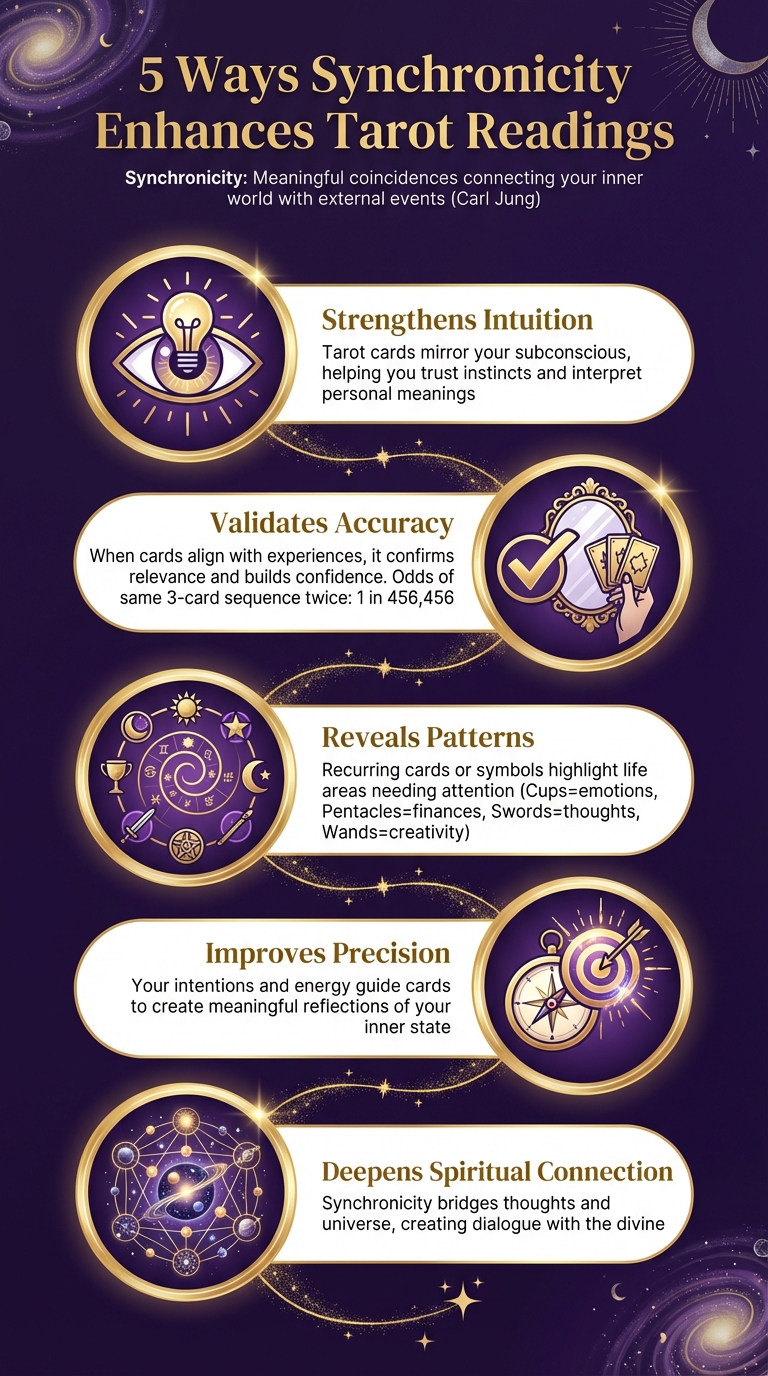
Synchronicity, a concept introduced by Carl Jung, explains how meaningful coincidences connect your inner world with external events. In tarot readings, synchronicity helps align the cards with your thoughts and emotions, turning the process into a powerful tool for self-discovery and guidance. Here’s how it works:
- Strengthens Intuition: Tarot cards reflect your subconscious, helping you trust your instincts and interpret personal meanings.
- Validates Accuracy: When cards align with your experiences, it confirms the reading’s relevance and builds confidence.
- Reveals Patterns: Recurring cards or symbols highlight areas in life that require attention.
- Improves Precision: Intentions and energy guide the cards, creating meaningful reflections of your inner state.
- Deepens Spiritual Connection: Synchronicity bridges the gap between your thoughts and the universe, fostering a sense of unity.
5 Ways Synchronicity Enhances Tarot Readings
Tarot and Synchronicity: Reading the World as Symbol with Matthew Mather
sbb-itb-2720e80
1. Strengthens Your Intuition
Shuffling a tarot deck taps into a deeper layer of your subconscious, guiding you toward cards that resonate with your inner thoughts and feelings.
Think of tarot cards as a mirror reflecting the motivations, needs, and truths that often remain hidden. Evelyn Stroud, a university lecturer and researcher, describes it perfectly:
"The choice of a card reveals what your higher self already knows".
This process acts like a tuning fork, helping you interpret those gut feelings and instincts you might not fully understand. By doing so, tarot readings become more personal and meaningful.
To build this intuitive connection, start by setting a clear intention for your reading. A focused mindset helps you notice the subtle synchronicities that emerge. When you approach the cards with an open mind and a desire for insight, you’re more likely to experience those meaningful moments.
When a card stirs up an emotional reaction or memory, trust that feeling over any guidebook explanation. As Nicholas Robinson explains:
"Your intuition is the reader. The card is just the mirror".
For example, if the Three of Swords reminds you of a personal experience rather than its traditional interpretation, take that as your unique message. To deepen this connection, begin by describing the card’s imagery and let your subconscious draw the connections to your life.
2. Validates the Reading’s Accuracy
When the cards align with your current experience, it’s like holding up a mirror to your inner world – it confirms the reading’s accuracy and resonates on a deeply personal level.
Carl Jung described synchronicity as a meaningful coincidence between external events and internal thoughts. Imagine pulling a card that perfectly reflects a private thought or a recent event you haven’t shared with anyone. That’s not just chance – it’s a moment that feels undeniably real and connected.
Tarot reader Chinggay captures this beautifully:
"Synchronicity can feel amazing and awe-inspiring… It’s validation that your intuition was on the right track and that your readings are impeccable".
This kind of validation works in two ways. For the seeker, it confirms that the cards are directly addressing their situation. For the reader, it boosts confidence in their ability to interpret the spread. The odds of drawing the exact same three-card sequence on back-to-back days are 1 in 456,456. So, when something that unlikely happens, it’s hard to dismiss its significance. These moments of alignment deepen both the seeker’s trust in the guidance and the reader’s confidence in their skills.
The cards act as a "sacred mirror", reflecting your energy and subconscious back to you. Seeing yourself in the spread not only validates your current path but also empowers you to trust and act on the insights you’ve received.
3. Reveals Recurring Patterns
After understanding how intuition and validation play a role in tarot readings, recurring patterns take things a step further by shining a light on deeper truths.
Synchronicity rarely happens just once. When the same card, number, or symbol keeps appearing across different readings, it can feel like the universe is practically nudging you to pay attention. These repetitions aren’t random – they’re meaningful patterns that deserve notice.
These patterns can show up in different forms. For example, seeing recurring numbers like 11:11 often signals heightened awareness. Similarly, repeated suits in your readings can highlight specific areas of life: Cups for emotions, Pentacles for finances, Swords for thoughts, and Wands for creativity or spirituality.
Tarot writer Julia Eve from Spiral Sea Tarot captures this idea perfectly:
"The universe is a giant fractal, continuously replicating and evolving – a dynamic that naturally draws your attention to these patterns".
Sometimes, these patterns extend beyond the cards and into the physical world. In one reading by Spiral Sea Tarot, a tiny glass Buddha statue broke at the neck, sparking a conversation about decapitation. Shortly after, the reader pulled an oracle card referencing an apostle’s beheading. These external events align with the reading, creating a complete message that feels far from coincidental.
Nicholas Robinson from Fires of Alchemy explains it like this:
"Tarot is more than chance – it acts like a tuning fork, resonating only when you’re ready to receive its message".
Recurring patterns, in this way, act as that tuning fork. They bring unconscious behaviors and hidden truths to the surface, giving you the opportunity to address them.
Here’s a tip: if a specific number keeps showing up in your readings, gather all four Minor Arcana cards with that number, shuffle them, and draw one. This can help reveal the area of life that needs your focus.
4. Improves Reading Precision
Synchronicity enhances the accuracy of tarot readings by aligning your inner state with the cards you draw, transforming seemingly random selections into meaningful reflections of your subconscious.
As Carl Jung explained, synchronicity isn’t about chance. Instead, the cards you choose reflect deeper psychological forces and inner wisdom at work. This alignment suggests there’s more than randomness influencing the process.
Your intentions play a key role, generating energy that interacts with the Universe to arrange the cards as a mirror of your inner truths. For example, if you’re questioning a work project and pull the 5 of Wands, it’s not just a coincidence – it might validate your gut feelings about potential challenges ahead.
This energetic connection creates a bridge between your inner world and the tarot spread, forming a personal narrative that resonates deeply. Charlene Belitz and Meg Lundstrom describe this beautifully:
"By using synchronicity for guidance, confirmation, and validation, people’s lives become a dance of energy with the Universe, a give and take with their environment that fills their days with insight and zest".
Recognizing recurring patterns in your readings can further refine their precision. By setting clear intentions and preparing your mind – through practices like journaling or meditation – you can invite synchronicity to guide you even more effectively.
5. Strengthens Your Spiritual Connection
Synchronicity doesn’t just improve accuracy or reveal patterns – it also deepens your spiritual connection. These meaningful coincidences can transform tarot readings from simple card pulls into profound conversations with a higher power, creating a deeply personal dialogue that enriches your spiritual journey.
As Frank, founder of Tarot Awakenings, puts it:
"When we experience synchronicity we get a brief glimpse of [the divine] and experience it for ourselves. The essence within us connects to the essence outside of us."
This type of connection breaks down the boundary between your inner thoughts and the external world, serving as a reminder that everything is interconnected. It’s a moment where separation feels like an illusion, and synchronicities become the universe’s way of affirming your spiritual path. These moments suggest that life is filled with meaning and that you’re in constant dialogue with the universe.
To nurture this connection further, start your readings with clear intentions. When you actively look for signs and remain open to them, you’re more likely to notice these synchronistic moments. Practices like meditation or journaling before a reading can help engage your "Deep Mind", making it easier to tap into spiritual insights.
What makes synchronicities even more compelling is their statistical rarity. When highly unlikely events align during a reading, it’s hard not to feel that the universe is actively engaging with you. These moments encourage you to shift from pure logic to a sense of spiritual awe, echoing Einstein’s belief that life itself is a miracle.
Conclusion
Synchronicity turns tarot readings into profound conversations with the universe. This article has explored how synchronicity sharpens intuition, validates insights, uncovers patterns, improves accuracy, and strengthens spiritual connections. As Carl Jung first suggested in the 1920s, synchronicity works outside the usual cause-and-effect framework, creating a link between your inner experiences and the external world.
What makes synchronicity so captivating is how it changes your perspective. Instead of seeing life as a series of random or linear events, you start to notice an interconnected web where every moment carries potential meaning. Evolutionary astrologer Maggie Jones Boyle puts it beautifully:
"Astrology, tarot, the runes, and any other form of divination is simply synchronicity in action. As above, so below. As within, so without."
By embracing this mindset, you open yourself to deeper guidance. Start each reading with clear intentions and practices like meditation or journaling to activate your "Deep Mind", the space where meaningful coincidences come alive. Pay attention to recurring numbers like 11:11 or 2:22, and trust that "aha" moment of recognition when it arises during a reading.
As you continue to develop your practice, resources like Intuitive Answers can support your journey. With daily tarot readings, horoscope forecasts, and articles on astrology, numerology, and the law of attraction, you’ll find tools to help you engage with synchronicity and uncover the patterns shaping your spiritual path.
FAQs
How is synchronicity different from luck in tarot?
Synchronicity in tarot is all about those moments when coincidences feel like they carry a deeper meaning – almost as if the universe is speaking directly to you. These aren’t random events or strokes of luck. Instead, they seem to form a purposeful connection, often aligning perfectly with your intuition or inner thoughts.
In tarot readings, synchronicity plays a key role by weaving together symbols and patterns that feel intentional. It’s as if the cards are mirroring your inner truths or delivering messages you need to hear. This sense of connection adds depth to the reading, offering guidance that feels more profound than mere chance.
How can I tell a real sign from confirmation bias?
When trying to tell a genuine sign apart from confirmation bias, ask yourself if the synchronicity genuinely feels relevant and offers insight into your current circumstances. It’s important to avoid reading too much into coincidences – they might just be your brain’s natural tendency to spot patterns or reflect your own hopes. Instead, pay attention to what truly resonates, rather than bending events to match expectations.
What should I do if I keep pulling the same card?
Repeatedly drawing the same tarot card is no coincidence – it often carries a message or lesson that you might not have fully processed yet. Take some time to dive deeper into the card’s meaning. Journaling about its themes can be a helpful way to uncover where you might be resisting its energy or guidance. This recurring card is like a nudge from the universe, urging you to pay attention to a specific area of your life that requires deeper focus or clarity.