Skip to content
Telepathy is the ability to communicate through thoughts without using words or physical signals. It’s often seen as a heightened form of intuition and can be developed with practice. This guide covers how telepathy works, why it’s useful, and practical steps to enhance your skills. Key takeaways:
- What It Is: A mental connection that bypasses traditional communication methods, often linked to intuition and emotional closeness.
- Why Learn It: Improves intuition, decision-making, and empathy while fostering deeper connections with others.
- How to Start: Build mental clarity through meditation, practice sending and receiving thoughts with a partner, and track progress in a journal.
Techniques like simple breathing exercises, visualization, and guessing games can help you strengthen your telepathic abilities over time. Consistency and an open mindset are crucial for success. Keep practicing daily to see gradual improvements.
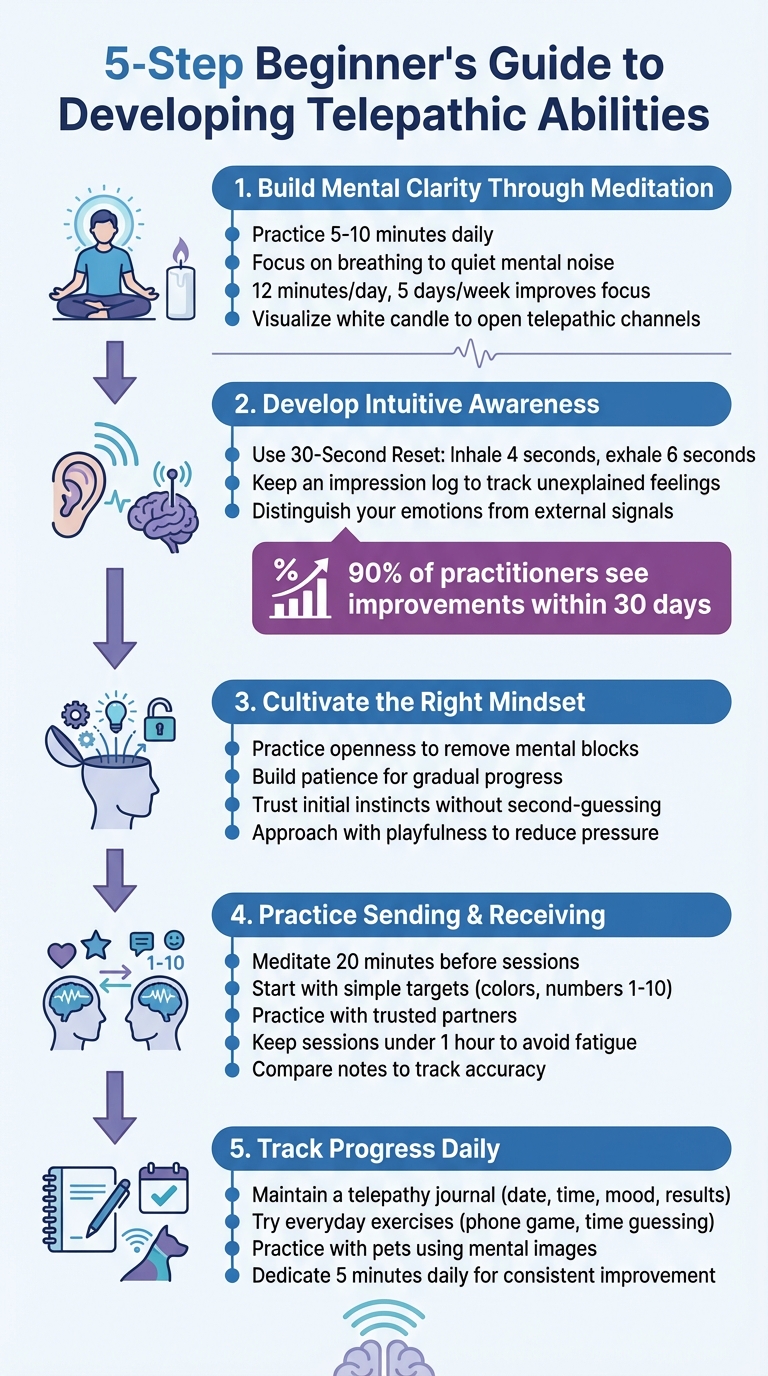
5-Step Beginner’s Guide to Developing Telepathic Abilities
"Telepathy" – How to send a telepathic message to someone… | Law of Attraction
sbb-itb-2720e80
Building Blocks for Telepathic Development
After understanding what telepathy is and its potential benefits, it’s time to lay a practical foundation for developing this skill. Before diving into telepathic exercises, it’s crucial to establish a strong mental base.
How Intuition Supports Telepathy
Intuition serves as the doorway to telepathy. Think of it as that gut feeling you get when you know someone is about to call, or the sudden emotional shift that seems to come out of nowhere. Telepathy builds on these intuitive channels that are already part of you.
The challenge lies in identifying the difference between your own emotions and those unprovoked feelings that might actually be external signals or "pings" from others. To sharpen this skill, take moments throughout the day to pause and assess your emotions. Keep an impression log to note sudden, unexplainable feelings, helping you separate internal emotions from possible telepathic signals. This practice strengthens self-trust, which is key to maintaining a clear connection. Interestingly, over 90% of individuals practicing energy work reported noticeable improvements in communication abilities within just 30 days.
A simple breathing technique, called the 30-Second Reset, can help you quiet your mind and enhance your intuitive awareness. Inhale for 4 seconds, exhale for 6 seconds, and repeat. This exercise reduces mental noise, making it easier to pick up on subtle telepathic impressions.
Once you’ve built this intuitive awareness, the next step is cultivating the right mindset to refine your telepathic abilities.
Developing the Right Mindset
Your mindset can either strengthen or block telepathic signals entirely. Doubt and skepticism are major hurdles – they can disrupt the connection before it even begins. As Hannah Brites explains:
"Adopting the mindset that telepathy is a natural extension of communication enhances one’s perception of their own telepathic abilities".
Patience is equally important. Telepathy isn’t about instant, dramatic breakthroughs. Instead, it’s a skill that develops gradually through regular practice. Expect subtle cues like fleeting images or gut feelings rather than dramatic, Hollywood-style mind reading. The term "telepathy" was first introduced in 1882 by Frederic W. H. Myers, and it has been studied systematically ever since. This isn’t a fringe concept – it’s a skill that grows over time.
Avoid overanalyzing or second-guessing the impressions you receive. Trust your initial instincts, even if they seem minor or insignificant. As World of Psychic puts it:
"Patience turns small hints into reliable information".
Approach telepathic practice with curiosity and a sense of fun rather than rigid expectations. A playful attitude helps reduce mental tension and performance anxiety, which can otherwise interfere with focus. Treat telepathic exercises as enjoyable experiments – try guessing who’s calling before you check your phone, or see if you can sense the time before looking at a clock.
| Mindset Component | Role in Telepathy | Practice Ideas |
|---|---|---|
| Openness | Removes mental blocks and doubt | Use affirmations or "intent statements" |
| Patience | Encourages steady, gradual progress | Dedicate 5–10 minutes daily to practice |
| Self-Trust | Reduces second-guessing | Keep a journal to validate your "hits" |
| Playfulness | Relieves mental pressure | Play guessing games with shapes or colors |
| Grounding | Maintains emotional balance | Visualize roots or engage in physical movement |
With the right mindset in place, the next step is creating an environment that supports your practice.
Setting Up Your Practice Space
Your surroundings play a significant role in telepathic development. Jennifer McVey, a spiritual director, advises:
"Find a position that you’re comfortable in, right in a space in your home (or wherever you’re going, or outside)…and let yourself slip into a deep meditative state".
Choose a quiet, distraction-free spot where you feel relaxed. Equip your space with essentials like a journal, timer, and optional tools such as crystals. For example, quartz can help with focus, while amethyst promotes calmness. Wear loose, comfortable clothing and find a sitting position that works for you – whether that’s on a meditation cushion or an upright chair.
To minimize distractions, consider sensory deprivation tools like blackout goggles or white noise headphones. These can help block out visual and auditory inputs, allowing you to focus entirely on mental signals. This approach ties back to the importance of mental clarity.
Before starting a session, do light stretching or yoga to release physical tension. Visualize a grounding cord connecting you to the Earth both before and after your practice. This technique helps maintain your energy and prevents mental fatigue.
Beginner Techniques for Practicing Telepathy
Now that you’ve got a solid foundation, it’s time to dive into some practical exercises. These methods are designed to help you gradually build telepathic skills in a structured and repeatable way.
Meditation for Mental Clarity
Meditation is key to clearing your mind and preparing it to receive telepathic signals. Think of it as tuning a radio – removing the static so you can hear the station more clearly. Start with 5 to 10 minutes a day. Sit comfortably, feet flat on the ground, with your palms facing upward to signal openness. Focus on your breath as it flows in and out. If your mind wanders, gently bring your attention back to your breathing.
According to neuroscientist Amishi Jha, meditating for just 12 minutes a day, five days a week, can improve your ability to focus. To heighten sensitivity, try a visualization technique: imagine each inhale pulling subtle energy into your body. You can also picture a white candle in your mind, symbolizing that your telepathic channels are open. When you finish, ground yourself by visualizing the candle being extinguished or by softly blowing into your palms to return to normal awareness.
Sending and Receiving Thoughts
Once you’ve developed mental clarity, you can move on to partner exercises to practice sending and receiving thoughts. Choose someone you trust, like a close friend or family member. Emotional bonds can make it easier to connect telepathically.
Here’s a simple process for practicing thought transmission:
- Both you and your partner should meditate for about 20 minutes beforehand to quiet your minds.
- The sender visualizes the receiver in detail, focusing on their image.
- Pick a simple target, such as a color, number (1–10), or basic object.
- The sender imagines the thought traveling from their mind to the receiver’s, mentally repeating the message and visualizing the receiver accepting it.
- The receiver stays relaxed and avoids overthinking or forcing answers.
- Afterward, both of you should write down what was sent and received, then compare your notes to see how closely they align.
To evaluate your progress, pay attention to any thoughts that feel external or distinct from your usual inner dialogue. You might notice subtle physical sensations, like tingling or pressure between your eyebrows, or even experience real-world coincidences – like thinking of someone just before they call you. Keep sessions under an hour to avoid mental fatigue.
Using Visual Aids and Symbols
Once you’re comfortable with basic telepathic exercises, visual aids can help refine your skills. They provide specific targets, making it easier to measure your progress. A deck of playing cards or simple geometric shapes is a great place to start.
Here are some exercises to try:
- Card exercise: The sender picks a card and focuses on its suit or number while the receiver writes down their impressions. Over time, check if your accuracy improves beyond random chance.
- Shape exercise: The sender draws a compound shape (like a triangle inside a circle) and visualizes it while the receiver sketches what they perceive. Even partial matches suggest progress.
- Animal practice: Visualize a specific action for your pet – like sitting or coming to you – and observe if they respond without physical cues.
Keep a dedicated log to track the details of your practice sessions. Recording consistent patterns can help you better understand your intuitive style. Interestingly, over 90% of individuals practicing energy work reported noticeable improvements in telepathic communication within just 30 days.
Daily Practices to Strengthen Telepathic Skills
Building telepathic abilities works best with short, consistent practice. Think of it like picking up a new skill – regular, small efforts often lead to better results than occasional, intense sessions.
Tracking Your Progress
Keeping a telepathy journal can help you monitor your growth. Jot down details like the date, time, mood, location, and specifics of your practice. Pay attention to patterns in your attempts. For instance, if you visualize "apple" and your partner picks up on "red" or "fruit", it shows your connection is starting to form. Over time, you might notice which factors, like the time of day or your emotional state, improve your accuracy. These notes can help you refine your approach and make telepathy a natural part of your daily life.
Telepathy in Everyday Life
You don’t need a complicated setup to practice telepathy. Try simple exercises like the "phone game": when your phone rings or buzzes, pause and try to sense who’s calling or texting before you check. Another idea is to guess the exact time before looking at a clock or predict what’s in an unopened email. To sharpen emotional awareness, occasionally ask yourself, "Is this emotion mine?" Sudden mood changes might be subtle telepathic impressions from others.
Practicing with Animals
Pets are great partners for telepathic practice since they naturally communicate through instinct and nonverbal cues. Try sending them simple mental images, like the taste of their favorite snack or the sensation of going for a walk. Watch for their reactions – maybe your cat approaches when you picture feeding time, or your dog perks up when you mentally call them. Notice if they respond without any obvious physical prompts, as this could signal a telepathic connection forming.
Overcoming Common Challenges
Learning telepathy is as much about overcoming mental hurdles as it is about practice. For beginners, doubts and the fear of failure can feel overwhelming, especially when progress feels slow or inconsistent. It’s easy to compare yourself to others and feel like you’re falling behind. On top of that, external skepticism – whether from family or friends – can add pressure, as not everyone is open to the idea of psychic phenomena. These challenges are normal, but they don’t need to hold you back. Here are some practical strategies to tackle them.
Handling Doubts and Skepticism
Self-doubt often stems from expecting instant success. Instead of seeing a failed attempt as evidence of inability, treat it as a chance to learn what conditions help you tune in better. If doubts about judgment from others weigh on you, write them down to clarify what’s really bothering you. For those moments when you feel overwhelmed by sensory input, try the "light switch" method: imagine flipping a switch to shut off your telepathic receptivity temporarily. Often, unsettling experiences are more about your subconscious or external media influences than actual spiritual communication.
Telling Intuition from Coincidence
Once you’ve started addressing self-doubt, the next hurdle is figuring out whether your impressions are genuine signals or just random chance. Keeping an "Impression Log" can help you track your thoughts and outcomes, making it easier to spot patterns over time. Ask yourself, "Does this emotion make sense in my current situation?" If you feel a sudden wave of anxiety or excitement that doesn’t match your environment, it might indicate a telepathic signal rather than just a mood swing. Over time, you might notice recurring patterns. For example, if you often associate "red" or "fruit" with an apple target, that could signal progress in your connection. To stay objective, keep a simple tally of your hits and misses – our minds tend to remember successes more vividly than failures.
Maintaining a Regular Practice
Consistency is everything. Studies show that over 90% of people who commit to energy work for just 30 days notice measurable improvement in their telepathic abilities. Make it a priority to practice daily, even if it’s just for five minutes. If you hit a mental block, try a quick 30-Second Reset to refocus. You can also make practice fun by trying low-pressure exercises, like guessing who’s about to call or predicting the time without looking at the clock. These playful drills not only keep things light but also help strengthen your telepathic skills over time.
Conclusion
You’ve delved into the foundations of telepathy, covering everything from honing intuition to practical meditation and tracking techniques. This journey has laid the groundwork for developing your intuitive skills and practicing telepathic exercises. Progress takes time, but consistency is key. As Scholistico aptly states:
"Mindset is important when practicing telepathy. You need to believe that you can do it in order to achieve success".
With regular practice, your telepathic abilities will naturally grow stronger.
Key Takeaways
Three essential elements form the backbone of telepathic development: belief in your abilities, consistent practice, and maintaining an open mind. Studies show that telepathy is closely tied to intuition and empathy, acting as an extension of natural human communication. Physical well-being also plays a role – getting adequate sleep, exercising, and eating a balanced diet helps prepare your body for the subtle energy shifts involved in telepathic communication. Psychic researcher Jeanne Anderson highlights this idea:
"Telepathy is an innate psychic ability within every individual… however most of us lose this tool… due to lack of [use]".
Tracking your progress can be incredibly helpful. Keep a journal to log your attempts, noting the date, time, target, and outcome. This practice can help you identify which techniques resonate most with you. Incorporating present-tense affirmations like "I am a powerful telepathic communicator" can also help align your mindset with your goals. And remember, ethical considerations are vital – always seek permission before initiating a telepathic connection with someone else.
Keep these principles in mind as you move forward with your practice.
Next Steps for Beginners
To build on these foundations, start with simple exercises to gradually strengthen your telepathic skills. Practice with trusted friends or even pets, focusing on sending basic images, words, or emotions. Tools like Zener cards, which feature five distinct symbols across a 25-card deck, can be a fun and effective way to test and enhance your extrasensory perception. When sending a message, visualize the recipient clearly and imagine "beaming" the information to them. When receiving, acknowledge the message to reinforce the connection.
If you’re curious about expanding your psychic abilities further, Intuitive Answers offers resources on astrology, tarot, and numerology. Exploring these complementary practices can deepen your understanding of energy work and intuitive communication.
Even dedicating just five minutes a day to practice can lead to noticeable improvements. The fact that you’re exploring this topic suggests your intuition is already awakening. Trust the process, stay consistent, and approach each session with patience and curiosity.
FAQs
How can I tell if a thought is telepathic or just my imagination?
Telepathic thoughts often stand out as clear and sudden, manifesting as a specific word, image, or emotion that seems to appear out of nowhere. These impressions usually have a distinct quality and can often be validated by the person who sent them.
On the other hand, imagined thoughts tend to feel more hazy, shaped by your own expectations or assumptions, and lack the sharpness of telepathic messages. To differentiate between the two, focus on the clarity and timing of the thought. Then, confirm with the other person whether they intended to send that message. By regularly practicing this kind of verification, you can sharpen your ability to tell telepathic impressions apart from imagination.
What are some signs that you’re improving in telepathy?
As you delve into telepathy, you might start noticing subtle yet exciting signs of progress. For instance, you could find yourself picking up on someone’s thoughts or emotions, finishing their sentences, or even knowing who’s calling before you glance at your phone. You might also feel a deeper awareness of others’ needs or experience flashes of heightened intuition.
These moments often suggest that your ability to connect with others’ mental and emotional energy is growing stronger. Stay consistent with your practice – telepathy is a skill that flourishes with time, dedication, and patience.
How can I find the right partner for practicing telepathy?
Choosing the right partner can make all the difference when it comes to practicing telepathy. Ideally, you want someone who’s open-minded, curious, and genuinely interested in exploring telepathic communication. A foundation of mutual trust and a judgment-free attitude is crucial – it ensures a safe and encouraging space for both of you to experiment and grow.
Practical considerations matter, too. Choose someone whose schedule aligns with yours so you can practice consistently. Both participants should be willing to alternate roles as the sender and receiver, try straightforward exercises like identifying shapes or images, and maintain a journal to track progress over time. A partner who offers calm and constructive feedback will not only help you refine your approach but also enhance the experience for both of you.
When you combine trust, openness, and a shared commitment, you’ll set the stage for a rewarding telepathic journey and mutual growth.