Skip to content
Tarot readings rely on symbols to convey deeper meanings and insights. Every detail in a tarot card – from colors to objects – carries significance, offering layers of interpretation. By understanding these symbols, you can move beyond fixed definitions and allow your intuition to guide you. Here’s a quick breakdown:
- Symbols as a Language: Tarot uses imagery like rivers, mountains, or colors to express emotions, energies, and truths.
- Archetypes: Universal themes like the Fool or High Priestess connect to shared human experiences.
- Types of Symbolism: Includes colors (e.g., red for passion), elements (e.g., Wands for fire), numbers, and nature.
- Major vs. Minor Arcana: Major Arcana reflects life-changing events, while Minor Arcana covers daily situations.
- Practical Steps: Observe symbols, relate them to the context, and build a narrative for meaningful readings.
To deepen your skills, practice journaling, meditating on cards, and starting with small spreads. Tarot symbolism helps bridge logic and intuition, turning card readings into personalized, insightful experiences.
Common Tarot Symbols based on the Rider Waite Smith tarot system
sbb-itb-2720e80
Understanding Tarot Symbolism Basics
A tarot deck consists of 78 cards – 22 Major Arcana and 56 Minor Arcana. Each card is rich with imagery, from the clothing of its figures to the animals depicted, all designed to reflect universal experiences and psychological truths. By grasping these fundamentals, you can better interpret the intuitive messages revealed in a reading.
The Role of Archetypes in Tarot
Archetypes are universal patterns rooted in the collective unconscious. They represent shared human experiences – like the Hero, the Mother, or the Sage – transcending time and place. In tarot, these archetypes shine brightest in the Major Arcana, which outlines "The Fool’s Journey", a symbolic path of spiritual growth and transformation.
For example, pulling the Magician card introduces the Creator archetype, representing your ability to manifest and shape your reality. Similarly, the Emperor embodies the Ruler archetype, symbolizing authority, structure, and protective boundaries. These archetypes aren’t just abstract ideas – they mirror aspects of your own inner world. As tarot expert TarotAtlas explains:
"Tarot doesn’t give you direct answers – it gives you yourself."
The Minor Arcana also incorporates archetypes, but on a more relatable, everyday scale. The Court Cards represent roles we often play: Pages as the Student, Knights as the Seeker, Queens as the Nurturer, and Kings as the Leader. These archetypes can help you identify patterns in areas like work, relationships, and daily life. This symbolic structure sets the stage for exploring the various layers of meaning within each card.
Types of Symbolism in Tarot
Tarot imagery is packed with layers of symbolism. Recognizing these categories can deepen your understanding of the messages in each card.
Elemental Symbolism
The suits of the Minor Arcana align with the classical elements:
- Wands (Fire): Action, passion, and creativity
- Cups (Water): Emotions, intuition, and relationships
- Swords (Air): Intellect, logic, and conflict
- Pentacles (Earth): Physical reality, money, and stability
For instance, a Wands card might highlight energy and ambition, while a Cups card could point to emotional connections.
Numerical Symbolism
Numbers carry specific meanings across the deck. Aces signify beginnings, Twos point to balance or partnerships, Fives often indicate conflict or change, and Tens represent completion and renewal.
Color Symbolism
Colors in tarot provide emotional and spiritual cues:
- Red: Passion, action, and grounding (Root Chakra)
- Blue: Communication and peace (Throat Chakra)
- Yellow: Confidence and opportunity (Solar Plexus Chakra)
- White: Purity and divine connection
Geometric Symbolism
Shapes add another layer of meaning. Circles symbolize wholeness and cycles, triangles represent transformation, and squares suggest stability and structure.
Nature and Object Symbolism
Symbols from nature and objects offer additional context. Mountains may represent challenges or goals, water reflects emotions and the subconscious, the Sun brings vitality and clarity, and keys hint at hidden wisdom. Animals also play a role: dogs symbolize loyalty, lions represent courage, and snakes can indicate temptation, hidden knowledge, or transformation.
As Tarot MasterGuide points out:
"Tarot is a language of symbols – and while most people focus on the names and keywords of the cards, the real wisdom often hides in the images themselves."
Understanding these symbolic layers helps you uncover deeper meanings. The interpretation of a symbol isn’t fixed – it shifts depending on the context, surrounding cards, and your intuitive insights, revealing the unique message each card holds.
Symbols in Major and Minor Arcana Cards
Building on the earlier discussion of symbolism, let’s explore how these symbols take shape in the Major Arcana and Minor Arcana. The Major Arcana reflects profound spiritual lessons and life-changing events – think of it as the "highlight reel" of your soul’s journey. In contrast, the Minor Arcana delves into everyday matters and practical concerns. Let’s break down how these symbols appear in each group.
Key Symbols in the Major Arcana
The 22 Major Arcana cards are central to Tarot readings, often pointing to major life shifts or external forces at work. Each card is rich with symbols drawn from mythology, astrology, and alchemy. For example, Justice features scales and a sword, representing fairness and accountability, while Death showcases a skeleton on a pale horse carrying a flagged flower, symbolizing transformation and renewal.
Celestial imagery plays a big role in the Major Arcana. The Sun radiates themes of joy, success, and enlightenment, while The Moon taps into the subconscious, fears, and hidden truths. The Star, on the other hand, brings a sense of hope and divine guidance after challenging times. Even smaller details carry weight: angels signify divine protection, lions embody courage and strength, and castles suggest safety and achievement.
"The Major Arcana Tarot cards reveal messages about the big picture of your life and its long-term direction." – Tarot.com
Interactions between characters and symbols are also meaningful. In Strength, a figure calmly tames a lion, illustrating the power of patience and inner resolve over brute force. Meanwhile, The Magician stands before a table holding all four suit symbols – wands, cups, swords, and pentacles – demonstrating mastery over every element of existence.
Symbolism in the Minor Arcana Suits
While the Major Arcana focuses on overarching themes, the Minor Arcana zooms in on the details of everyday life. With 56 cards, this part of the deck represents daily events and influences. Each suit carries distinct elemental associations.
- Wands (Fire): Symbols like lizards, sunflowers, lions, and desert landscapes reflect creativity, ambition, and initiative in readings.
- Cups (Water): Imagery such as fish, mermaids, oceans, and shells highlights emotional depth and relationships.
- Swords (Air): Mountains, clouds, birds, and butterflies point to intellectual challenges and decision-making.
- Pentacles (Earth): Gardens, bulls, pomegranates, and coins ground interpretations in material resources and tangible outcomes.
The numbered cards (Ace through Ten) add another layer of meaning through numerology. Aces often signify new beginnings, while Tens mark the completion of a cycle or journey. Court Cards – Pages, Knights, Queens, and Kings – can represent specific individuals or aspects of your personality, each aligned with the energy of their suit.
"If the Major Arcana is the highlight reel of your life… the Minor Arcana is the day-to-day plotline. It’s what you said in the meeting. It’s the text you didn’t send." – Tarot.com Staff
When a reading features mostly Minor Arcana cards, it indicates a focus on immediate, actionable circumstances. These cards guide you to address current patterns and practical matters that demand attention.
How to Incorporate Symbolism in Tarot Readings
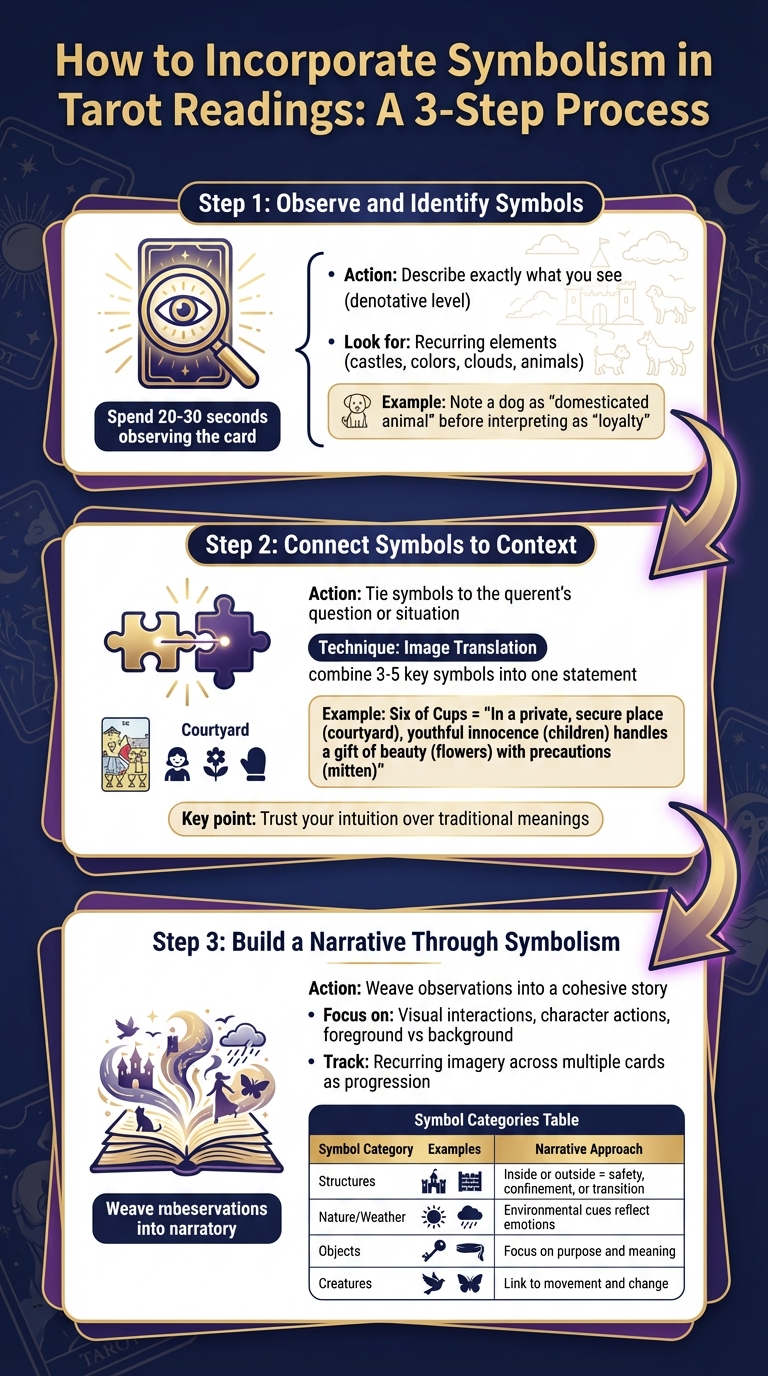
3-Step Process for Incorporating Symbolism in Tarot Readings
Now that you’re familiar with the symbols in both the Major and Minor Arcana, it’s time to bring that knowledge to life. This three-step process will help you move beyond simply recognizing symbols, allowing you to create readings that feel meaningful and personal. The method blends shared, traditional interpretations with your own intuitive insights, ensuring a balanced approach.
Step 1: Observe and Identify Symbols
Start by spending 20–30 seconds carefully observing the card. Begin with the denotative level, which means describing exactly what you see without jumping to interpretations. For instance, if you spot a dog, note it as a domesticated animal before considering abstract ideas like "loyalty". This step ensures you don’t overlook important details.
"The cards have no meaning outside of the context of a questioner, a question, and any other cards laid out." – Joy Vernon, Tarot Teacher
Look for recurring elements throughout the spread. Are castles appearing in multiple cards? Do you notice repeated colors, clouds, or animals? These patterns can shape the overall mood of the reading and provide clues about the querent’s situation.
After noting these visual elements, begin interpreting their meanings within the reading’s context.
Step 2: Connect Symbols to Context
Once you’ve identified the symbols, tie them directly to the querent’s question or situation. Think about how each symbol functions in everyday life. For instance, a key might suggest unlocking hidden knowledge or protecting something valuable. Similarly, a wall could represent safety or a barrier, depending on whether it’s keeping someone in or out.
Use the Image Translation Technique to combine the literal meanings of 3 to 5 key symbols into a single statement that reflects the querent’s context. For example, with the Six of Cups, you might interpret the imagery as:
"In a private, secure place (courtyard), youthful innocence (children) handles a gift of beauty (flowers) with precautions (mitten)."
If the querent is asking about a new relationship, this could suggest that while affection is present, there’s still a sense of caution.
Trust your intuition here. If a symbol traditionally associated with "stability" feels more like "restriction" in a particular reading, follow that instinct. You can also use symbols to ask deeper questions – for example, if a guard appears, you might ask, "What are you protecting or keeping watch over?".
Step 3: Build a Narrative Through Symbolism
Now it’s time to weave your observations into a cohesive story. Each symbol carries both a traditional meaning and a personal resonance, and together they form the backbone of your reading. Imagine the card as a scene from a movie: describe the figures, their actions, and the setting. Pay attention to visual interactions – what are the characters holding, where are they looking, and what’s happening in the foreground versus the background?
"In the match-up between the book and your intuition, your intuition always wins." – Brigit Esselmont, Founder of Biddy Tarot
If the same imagery appears across multiple cards, consider it a progression or sequence of events. For instance, if a castle shows up in three cards, ask whether the querent is approaching it, staying inside, or leaving it behind. This can create a timeline that adds depth to your interpretation. Focus on a symbol that resonates strongly with your intuition and build your narrative around it.
Here’s a quick guide to help you craft narratives based on common symbol categories:
| Symbol Category | Examples | How to Build Narrative |
|---|---|---|
| Structures | Walls, Castles, Bridges | Note whether the querent is inside or outside – this can suggest safety, confinement, or transition |
| Nature/Weather | Clouds, Rain, Sun | Use environmental cues to reflect emotions – stormy skies for turmoil, clear skies for peace |
| Objects | Keys, Blindfolds, Globes | Focus on their purpose: keys for unlocking secrets, blindfolds for hidden truths, globes for personal worlds |
| Creatures | Birds, Dogs, Butterflies | Link these to movement and change – birds for freedom, dogs for loyalty, butterflies for transformation |
Exercises to Strengthen Symbolic Intuition
Building a strong connection with symbolic meanings doesn’t require complicated rituals. These three exercises can seamlessly fit into your daily life, helping you shift from relying on guidebook definitions to trusting your own interpretive instincts.
Journal Your Symbolic Observations
One of the best ways to sharpen your symbolic understanding is by keeping a tarot journal. Brigit Esselmont, Founder of Biddy Tarot, describes this as creating "a unique and personal connection with the Tarot cards" while putting "your intuition on speed dial". By journaling, you can develop your own symbol library, blending traditional meanings with interpretations shaped by your personal experiences.
Start with the "5-10 Word" Rule: before consulting any guidebook, write down 5 to 10 words or phrases that describe the imagery, colors, and symbols on the card. This method encourages observation first, interpretation second. For a simple daily practice, pull one card each morning and jot down how its symbols relate to your mood or the day’s events. At the end of the day, revisit your notes to see how your intuition aligned with your experiences.
Whether you prefer a physical notebook or a digital tool, the key is consistency in recording your insights.
Practice with 1-Card or 3-Card Spreads
Smaller spreads are perfect for focusing on individual symbols without the complexity of larger layouts. A 1-card draw is a great starting point – ask yourself, What feeling does this scene evoke? Then, document your immediate emotional and visual reactions.
For 3-card spreads, practice creating a narrative by linking the symbols across cards. Simple layouts like Past/Present/Future or Situation/Action/Outcome work well. Describe the imagery aloud, paying attention to actions, colors, and how the background shifts from one card to the next. This approach reinforces the idea that symbols take on different meanings depending on the question and the surrounding cards.
Meditate on Tarot Symbols
Meditation helps you bypass the conscious mind, diving into the subconscious where intuitive understanding thrives. Select a card and spend 20 minutes visualizing it as a life-sized scene. Begin with rhythmic breathing to quiet your thoughts, then imagine yourself stepping into the card’s world.
Once inside, engage all your senses – notice textures, sounds, and even scents. If the card features a character or creature, imagine becoming them. Ask yourself: What does it feel like to be this figure? What message do I carry?. Before leaving the meditation, take a final look around for details you might have missed during your initial observation.
"Meditation offers a way to go even deeper into the meaning and symbolism of each Tarot card as it allows us to bypass the conscious mind and dive into the subconscious mind and connect with your intuition." – Brigit Esselmont, Founder of Biddy Tarot
Afterward, jot down your meditation experience in your journal. This bridges the gap between subconscious insights and analytical thinking, enriching your overall tarot practice.
Conclusion
Recap of Symbolism’s Role in Tarot
Symbolism acts as the bridge between conscious thought and intuitive understanding. It transforms the static imagery of tarot cards into a dynamic language that connects directly with your intuition. By peeling back the layers of each card, you unlock a deeper, more adaptable understanding that allows every reading to resonate with the querent’s unique situation.
Symbolism reflects the unconscious, offering insights that go beyond surface-level interpretations. Whether it’s the way a figure is positioned, the subtle details in a card’s background, or recurring themes across a spread, these visual elements guide you toward richer, more nuanced interpretations. This approach not only enhances the depth of your readings but also sets a strong foundation for continuous growth in your practice.
Continue to Practice and Refine Your Skills
Building a strong connection with symbolism takes time and consistent practice. A great way to start is by pulling one card each day and observing how its imagery shows up in your daily life. Pay attention to familiar symbols – like a castle or a bird – and notice how their meanings shift depending on context. Keep a journal to document both traditional meanings and your personal impressions. Over time, this habit will help you create a blend of collective knowledge and your own intuitive insights.
As Brigit Esselmont wisely advises:
"In the match-up between the book and your intuition, your intuition always wins".
Trust that the patterns and symbols you notice aren’t random – they’re reflections of your inner world speaking through the cards. Use spreads, meditation, and journaling as tools to sharpen your intuition and deepen your connection to the symbolic language of tarot.
FAQs
How can I use my intuition to understand tarot symbols?
To understand tarot symbols on a deeper level, it’s important to develop a personal connection with the imagery. While traditional meanings offer a helpful foundation, take the time to explore what each symbol brings to mind for you. Does it stir a particular feeling, memory, or instinct? These personal reactions are key.
Trust your first impressions and allow your intuition to guide you. Tarot symbols are meant to ignite your inner wisdom, so let your interpretations unfold naturally. The more you practice and reflect, the better you’ll get at uncovering layers of meaning within the cards.
What role do colors play in tarot symbolism?
Colors in tarot symbolism hold a key role in deepening the interpretation of each card. They carry emotional, psychological, and spiritual meanings, allowing readers to connect more fully with the card’s energy. For instance, red is often linked to passion and vitality, while blue conveys calmness and truth.
By grasping these color meanings, tarot readers can uncover more nuanced messages within a spread. Colors resonate with our subconscious, triggering emotional reactions that make readings feel more intuitive and layered. For example, yellow is associated with joy and creativity, while green represents growth and renewal. Understanding these connections adds depth and insight to the tarot experience.
What role do archetypes play in understanding tarot cards?
Archetypes are powerful, universal symbols that capture essential elements of the human experience. These symbols are at the heart of tarot cards, offering a lens through which we can explore core traits, behaviors, and life roles. In the Major Arcana, archetypes like The Fool, The Magician, and The High Priestess embody profound life themes and spiritual milestones, making them key to understanding the cards’ deeper meanings.
Psychologist Carl Jung introduced the idea of archetypes as shared symbols within the collective unconscious, which explains why similar themes resonate across different cultures and mythologies. In tarot, these archetypes serve as reflective tools, helping readers uncover hidden truths, navigate challenges, and identify paths for personal growth. When you grasp the essence of these symbols, your readings can become a gateway to deeper self-awareness and spiritual insight.