Skip to content
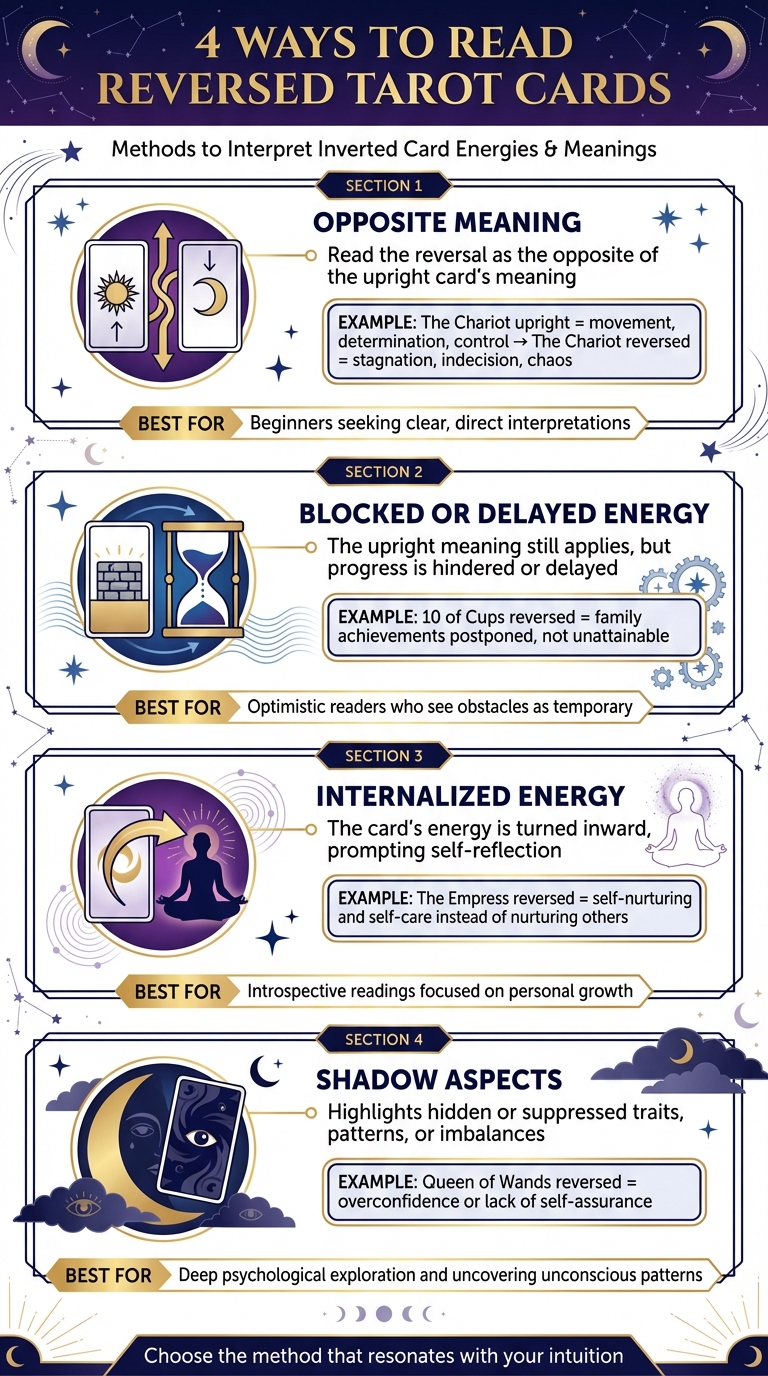
When a tarot card appears reversed, it offers a different perspective compared to its upright position. Reversed cards often focus on internal struggles, subconscious shifts, or hidden truths, rather than external events. While they may seem intimidating at first, understanding their meanings doesn’t require memorizing twice as much information. This guide outlines four practical methods to interpret reversed tarot cards:
- Opposite Meaning: Read the reversal as the opposite of the upright card’s meaning (e.g., success becomes obstacles).
- Blocked or Delayed Energy: The upright meaning still applies, but progress is hindered or delayed.
- Internalized Energy: The card’s energy is turned inward, prompting self-reflection or personal growth.
- Shadow Aspects: Highlights hidden or suppressed traits, patterns, or imbalances.
Each method can add depth and clarity to your readings. Choose the approach that resonates with your style, and let the surrounding cards provide context. Experiment with these techniques to find what works best for you.
4 Methods to Interpret Reversed Tarot Cards
4 Easy Ways to Read Reversed Tarot Cards
sbb-itb-2720e80
1. Opposite Meaning
A straightforward way to interpret a reversed tarot card is by seeing it as the opposite of its upright meaning. For example, a card that symbolizes success in its upright position might suggest failure or obstacles when reversed. Similarly, a card representing freedom could indicate feeling trapped. This approach is particularly popular among beginners because it provides a clear and direct method for understanding reversals.
To use this method, start by identifying the main qualities of the upright card and then think about their opposites. Take The Chariot as an example: upright, it represents movement, determination, and control. When reversed, it might suggest stagnation, indecision, or chaos. Another example is The World, which signifies success, completion, and growth in its upright position but may imply failure or a sense of being stuck when reversed.
"Many Tarot readers who use reversals simply believe the reversed Tarot card delivers the exact opposite message of the upright card." – Tarot.com Staff
This approach can also be a helpful fallback if you find yourself stuck during a reading. It allows you to keep the session moving while maintaining focus. However, it’s crucial to consider the surrounding cards for context. Without this, an "opposite" interpretation might feel overly negative or fail to align with the overall message of the reading. Some experienced readers warn against relying solely on this method, as it can lead to one-dimensional interpretations.
If you decide to use this technique consistently, it’s a good idea to establish this framework before starting a reading. Make sure you’ve mastered the meanings of the 78 upright cards first. Once you have a solid grasp of each card’s essence, interpreting reversals as their opposites will feel more intuitive. This foundational understanding can also help you move toward more nuanced ways of interpreting reversed cards in the future.
2. Blocked or Delayed Energy
Reversed tarot cards can also signify blocked or delayed energy. In this approach, the upright meaning of the card still applies, but something is preventing its full expression. Instead of interpreting reversals as inherently negative, this perspective frames them as temporary obstacles, offering a more optimistic outlook.
"It’s possible your reversed Tarot card is simply trying to tell you there will be a block or delay before the upright meaning of the card is fulfilled." – Tarot.com Staff
This interpretation encourages patience and understanding. For example, a reversed 10 of Cups might indicate that family achievements are postponed, not unattainable. Similarly, a reversed Ace of Wands suggests a creative idea is momentarily stuck, waiting for the right conditions to ignite.
The real challenge lies in figuring out what’s causing the blockage. The cards around the reversal can provide valuable insights. Is the delay tied to external factors, missing opportunities, or internal struggles? Brigit Esselmont, Founder of Biddy Tarot, explains:
"Energy can often appear in our lives, but it gets blocked or isn’t being expressed in the most constructive way possible."
When faced with a blocked energy reversal, ask yourself: What’s standing in the way of this energy? This question can help uncover the root of the issue. A delay doesn’t mean the energy won’t flow – it just means patience and effort are needed to remove the roadblocks.
3. Internalized Energy
Reversed tarot cards often point to energy that’s turned inward, highlighting inner thoughts, personal realizations, and subtle changes that might go unnoticed by others. This interpretation shifts the focus from external events to what’s happening within, encouraging introspection and self-awareness.
Unlike delayed energy, which suggests external barriers, internalized energy calls for self-reflection. It’s about looking inward rather than outward for answers or understanding.
Brigit Esselmont from Biddy Tarot offers a helpful way to interpret this:
"To make things really simple, take the upright meaning of the Tarot card, and then add ‘self’ or ‘private’ to the interpretation."
For instance, the upright Empress symbolizes nurturing others and creating abundance in your surroundings. When reversed, the card suggests self-nurturing – focusing on your own well-being and self-care. Similarly, while the upright Six of Wands represents public recognition and external validation, its reversed version emphasizes private victories and self-recognition, encouraging you to celebrate your accomplishments quietly.
When a reading contains mostly reversed cards, it often signals that the energy is concentrated inward. Esselmont elaborates:
"If your Tarot reading is mostly reversed cards, then you know you’re dealing with yourself and any required actions or changes need to happen within you first."
This perspective helps dispel the negative connotations often associated with reversed cards. A reversed Ace of Cups, for example, doesn’t mean love has been lost. Instead, it suggests focusing on self-love and finding emotional fulfillment within. Similarly, a reversed Four of Swords isn’t about avoiding rest – it’s a call to seek inner peace and mental clarity. The energy of reversed cards remains powerful, but it’s directed inward, offering an opportunity for reflection and personal growth.
4. Shadow Aspects
Reversed cards don’t just nudge you to look inward – they also shine a light on the shadowy corners of your psyche. These cards bring forward the hidden or unconscious energies of a situation, revealing traits, patterns, or circumstances you might habitually suppress. While upright cards often represent what’s visible or straightforward, reversed cards challenge you to dig deeper, uncovering imbalances or issues buried beneath the surface.
Tarot reader and mentor Carrie Mallon puts it perfectly:
"Meanings on the light side of the spectrum are more readily apparent, meanings on the shadow side of the spectrum are more unconscious and insidious."
Shadow aspects often reflect an imbalance in a card’s energy. Take the Queen of Wands, for instance. Upright, she radiates confidence and charisma, but reversed, she might point to overconfidence – becoming domineering – or a lack of self-assurance, where her presence feels muted. The Six of Cups reversed might hint at being overly attached to the past, creating an invisible wall that keeps you from fully embracing the present. Similarly, a reversed Tower card could suggest resistance to letting go of a failing structure, driven by a fear of temporary discomfort. And the Two of Wands reversed? That might be a hesitation to take charge or assert yourself when the moment calls for it.
To engage with these shadow aspects, observe the imagery of the reversed cards closely and consider the context provided by surrounding cards. These insights don’t just highlight where things may be out of balance – they offer a chance for growth. By addressing these hidden dynamics, you can work toward restoring harmony and uncovering deeper self-awareness.
Conclusion
Using the methods outlined above, working with reversed tarot cards can become a meaningful tool for self-reflection and deeper understanding. You now have four practical approaches to consider: interpreting reversals as opposites, identifying blocked or delayed energy, exploring internalized energy, and delving into shadow aspects. None of these methods is the "right" way – they’re all pathways to discovering what resonates most with you. As Brigit Esselmont, Founder of Biddy Tarot, puts it:
"Tell the Universe prior to a reading how you are choosing to read reversals… This way, the Universe will present your message to you through the most relevant cards."
Let your intuition guide you. Whether you set a clear intention before shuffling or allow the surrounding cards to shape your interpretation, you’ll find your own rhythm over time. Experimentation is key – test these approaches and see what fits naturally into your readings.
For those just starting out, try working with reversals for one full moon cycle. This can help you get comfortable with the process and decide how they enrich your practice. And if you ever feel stuck, take a moment to study the imagery of the reversed card. Sometimes, the visual details can spark the insight you’re looking for.
To deepen your tarot journey, explore resources like Intuitive Answers, where you’ll find daily tarot readings, personalized guidance, and tools to enhance your practice. Whether you’re focusing on reversed cards or seeking clarity in love, career, or personal growth, visit Intuitive Answers to connect with your intuition and unlock the wisdom within the cards.
FAQs
What’s the best way to interpret reversed tarot cards?
The way you interpret reversed tarot cards largely depends on your experience level, the purpose of your reading, and what feels most natural to you. If you’re just starting out, a straightforward method is to view reversed cards as a pause or a blockage, while focusing on the upright meanings. This keeps things simple as you build confidence.
For those with more experience, reversals can offer a richer perspective. They might indicate internal resistance, imbalanced energy, or even hidden opportunities. This approach adds layers to the reading without automatically associating reversals with negative outcomes.
To find what works best for you, think about how comfortable you are with complexity, the goal of your reading, and what aligns with your intuition. Try experimenting with different techniques and observe what feels the most meaningful. With practice, you’ll discover the approach that complements your style and deepens your tarot readings.
What should I do if most of the cards in my tarot reading are reversed?
If your tarot spread is filled with reversed cards, don’t panic – it’s actually a chance to dig a little deeper. Reversed cards often hint at energy that’s blocked, delayed, or turned inward. Take a moment to pause, breathe, and reflect on the situation to figure out what might need your attention.
Here are some common ways to interpret reversed cards:
- Opposite meaning: The reversed card could suggest the opposite of its upright meaning.
- Weakened or delayed energy: The card’s influence might feel less intense or could be on hold.
- Internalized energy: It might point to themes that are more personal or happening beneath the surface.
- Reevaluation or release: The card could be nudging you to revisit or let go of its theme altogether.
Try out these approaches and see what resonates with your reading. If reversals feel like too much to handle, that’s okay – they’re not mandatory. You can stick to reading upright cards for a while or change how you shuffle to limit reversed cards. Tarot is all about flexibility, so trust your instincts and let them lead the way!
Can reversed tarot cards have positive meanings?
Reversed tarot cards don’t always point to something negative. In fact, they can highlight hidden strengths, moments of growth, or even a shift toward something better. Instead of seeing them as bad news, think of them as opportunities for deeper understanding and self-reflection.
The meaning of a reversed card often depends on the context of the reading. It might suggest overcoming obstacles, resolving a tough situation, or even flipping the upright meaning on its head – turning a challenging card into a sign of relief or fresh possibilities. By staying open to these interpretations, you can uncover their positive aspects and add depth to your tarot practice.