Skip to content
A Yes or No tarot spread is a quick way to get clear answers to your questions. It provides a straightforward "yes", "no", or "maybe", while also offering insight into the energies influencing your situation. Here’s how to get started:
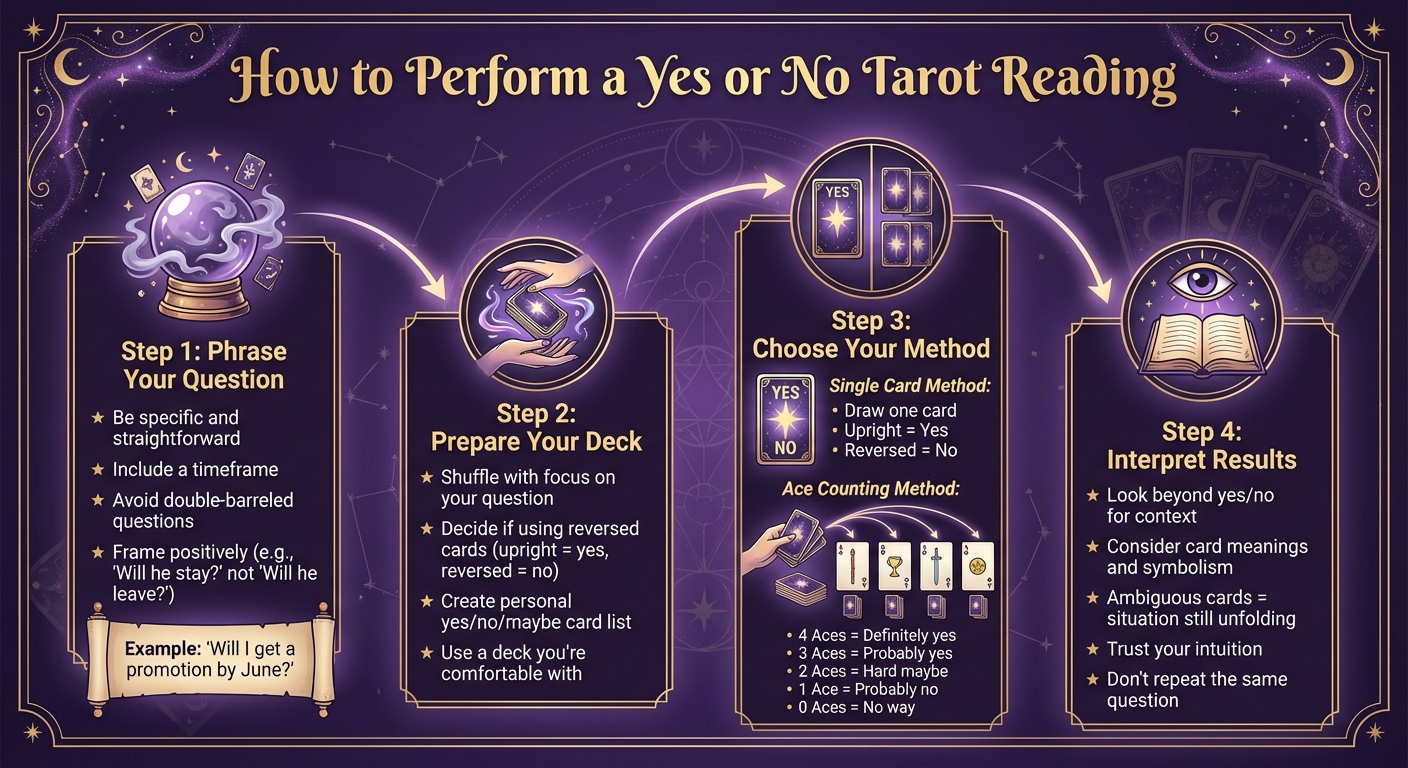
- Phrasing Your Question: Be specific and avoid vague or double-barreled questions. For example, instead of "Will I be successful?", ask "Will I get a promotion by June?"
- Preparing Your Deck: Shuffle with focus, decide if you’ll use reversed cards, and consider creating a personal "yes", "no", and "maybe" card list.
- Methods:
- Single Card: Upright = yes, reversed = no.
- Ace Counting: Count Aces across four piles; more Aces = stronger yes.
- Interpreting Results: Look beyond the simple answer. Card meanings and context provide additional clarity. Neutral or ambiguous cards may suggest the situation is still unfolding.
Yes or No spreads are tools for guidance, not fixed predictions. They reflect current energies, helping you make informed decisions. Trust your intuition and approach readings with an open mind.
How to Perform a Yes or No Tarot Reading: Step-by-Step Guide
Preparing for a Yes or No Tarot Reading
How to Phrase Your Question
The way you word your question plays a big role in the clarity of the answer. Keep it specific and straightforward – your question should be something that can be answered with a simple "yes" or "no." Avoid vague or overly broad questions that leave too much room for interpretation.
For example, instead of asking, "Is this a good company to work for?", make it more personal: "Is this company a good fit for me?". Similarly, "Will I be wealthy?" is too general. A better version could be, "Will my chosen career bring me financial security?". Adding a time frame can also help narrow down the response. Also, steer clear of double-barreled questions like "Will I meet a partner and get married next year?" If the answer is "no", it won’t clarify which part of the question is being addressed. Instead, ask something like, "Will Johnny Depp call me to arrange a romantic date by the end of April?".
When phrasing your question, frame it so that a "yes" aligns with the outcome you hope for. For instance, instead of asking, "Will he leave me?", rephrase it as, "Will he stay with me?". This way, positive cards reflect positive outcomes.
Avoid "should" questions like "Should I meet Tim in town?" Tarot isn’t about commands; it’s about guidance, and the final decision is always yours. Catherine from Tarot Elements offers this insight:
If you normally use reversed tarot cards in your readings, then using them in your yes no tarot questions makes sense.
Once you’ve asked your question, trust the answer you get. Repeatedly asking the same question can muddle the energy and lead to less accurate results.
With your question ready, it’s time to prepare your deck for the reading.
Preparing Your Tarot Deck
Before diving into the reading, take a moment to connect with your deck. Shuffle the cards thoughtfully, focusing your energy on your question. You can either shuffle and cut the deck or spread the cards out and select one intuitively.
Decide in advance whether you’ll use reversed cards and what they’ll mean for your reading. Generally, upright cards indicate "yes", while reversed cards suggest "no" or "not now". Some readers prefer to skip reversed cards altogether. Another option is to create your own list of "yes", "no", and "maybe" cards, based on how you personally interpret each one. This list can evolve as your understanding deepens over time.
Take your deck’s unique characteristics into account. Different decks can have varied interpretations, so stick to the one you feel most comfortable working with. Court cards, for example, can be tricky – if you associate a particular court card with something negative, you might want to place it in your "no" category.
Once your deck is ready, it’s time to set up a calm environment to help you focus.
Setting Up Your Space and Mindset
Find a quiet spot where you won’t be interrupted, and turn off any distractions. Set the mood by lighting a candle or incense to create a peaceful atmosphere.
Take a few deep breaths to clear your mind. Sarah Regan, Spirituality & Relationships Editor at mindbodygreen, shares her approach:
Usually, I take a few moments to relax, meditate, and contemplate my question. Sometimes I light a candle or incense.
Writing your question down can help ensure it’s clear and focused.
Finally, keep an open mind during the reading. Tarot offers guidance and reflects energy – it doesn’t dictate fixed outcomes. Focus on your desired outcome, but stay honest with yourself. Let your intuition guide you and trust your first instinct – it’s often the most accurate.
Simple Yes or No Tarot Methods
Single Card Upright or Reversed Method
This is one of the easiest ways to get a quick answer from your tarot deck. Shuffle your cards, draw one, and check its orientation. If the card is upright, the answer is "yes." If it’s reversed (upside down), the answer is "no".
This method is great for beginners and works best when you have a specific, clearly phrased question in mind. While it avoids the complexity of larger spreads, the card’s symbolism can sometimes add extra layers to the answer. If you’re after something with a bit more depth, the Ace Counting Method might be a better fit.
Ace Counting Method
The Ace Counting Method, made popular by tarot reader Xia Hunt, takes a more detailed approach to yes-or-no questions. To use this method, shuffle your deck while focusing on your question, then divide it into four equal piles. Flip through each pile until you find an Ace or reach 13 cards – whichever comes first. Count the total number of Aces across all the piles.
The results are interpreted as follows:
- 4 Aces: "Definitely yes"
- 3 Aces: "Probably yes"
- 2 Aces: "Hard maybe"
- 1 Ace: "Probably no"
- 0 Aces: "No way"
For example, in a reading that yielded 2 Aces (a "hard maybe"), the Ace of Swords suggested the need for careful planning and clarity, while the Ace of Cups highlighted emotional support. The absence of the Ace of Pentacles pointed to financial instability, and the missing Ace of Wands hinted at a lack of passion or potential conflicts. This method provides a more nuanced perspective while still offering a clear answer.
Interpreting Yes or No Tarot Answers
Understanding Yes, No, and Maybe
Once you’ve chosen your reading method, the next step is interpreting the cards. But here’s the thing – not every tarot spread delivers a straightforward yes or no. Sometimes, you’ll draw a card that’s ambiguous, which might mean the answer isn’t clear yet, the situation is still unfolding, or the timing just isn’t right. Cards like The Lovers or Temperance, for instance, often suggest that the outcome depends on multiple factors rather than offering a definitive yes or no.
When faced with unclear results, pay attention to the emotions or tone the card conveys. Its feeling might tell you more than any textbook definition ever could. And if you notice conflicting answers – like asking "Will I get the job?" followed by "Will I lose the job?" and getting mixed signals – that’s your cue to pause and reframe your question so it aligns with your true intentions.
This sense of ambiguity can actually open the door to a deeper level of interpretation, as we’ll explore next.
Using Card Meanings for More Context
Even in a yes-or-no reading, tarot cards can offer insight into the "why" behind the answer. The traditional meaning, suit, and imagery of a card all add layers of context. For example, if you draw The Fool upright while asking about a new job, it might suggest an exciting opportunity or a fresh start. On the other hand, if you ask, "Will I lose the job?" and The Fool appears, it could point to a beneficial change, even if it feels uncertain at first.
Major Arcana cards often highlight bigger spiritual lessons or events tied to destiny, while Minor Arcana cards tend to focus on outcomes you can shape through your actions. Neutral cards like The Hierophant require you to factor in the context – what might mean "yes" in one situation could mean "no" in another.
Reversed cards add another layer of complexity. They can signal delays or suggest that things aren’t as they seem. For instance, a reversed positive card might caution against misplaced optimism, while a reversed negative card could imply you’ve dodged a potential setback.
Responsible Tarot Reading Practices
Tarot works best as a tool for reflection, not as a definitive answer machine. Asking the same question repeatedly can muddy the waters rather than provide clarity. If a yes-or-no approach feels too limiting, consider switching to an open-ended question that allows for deeper exploration. For example, instead of asking, "Will I get the job?", try rephrasing it as, "What energies are influencing my job prospects?" This approach can provide a richer understanding of your situation.
sbb-itb-2720e80
Conclusion and Next Steps
Key Takeaways
Yes or no tarot spreads are a straightforward way to get clear answers when you’re seeking guidance. The secret lies in preparation: frame your question carefully, starting with phrases like "Do I…" or "Will I…", and include a specific timeframe. Once you’ve crafted your question, select a spread that resonates with you and trust your intuition as you interpret the cards. Keep in mind, tarot readings reflect current energies and possible outcomes – they’re not set in stone. The future can shift with new choices or insights, making these readings a tool for self-awareness rather than absolute predictions.
Mastering these basics sets the stage for more in-depth exploration.
Expanding Your Guidance Practice
Once you’re comfortable with yes or no spreads, you might want to explore more intricate layouts that dig into the "hows" and "whys" of a situation. Spreads like the Celtic Cross or a 12-card astrological house spread can provide a broader perspective on your life. Keeping a tarot journal to document your questions and the outcomes can help you build confidence in your intuition and identify patterns over time.
For additional daily insights, consider incorporating resources like Intuitive Answers, which offers horoscopes, astrology updates, and numerology content to complement your tarot practice. Combining tarot with daily, weekly, or monthly horoscopes can give you a richer understanding of the energies shaping your journey. Whether you’re pulling a single card for a quick check-in or using a larger spread for significant decisions, these tools work together to support your personal growth.
"Tarot is a valuable self-discovery and self-reflective tool that allows you to dive deeper into your thoughts and feelings – not avoid making life decisions, whether big or small!" – Annie, The Tarot Professor
How to Do a Yes / No Reading | Tarot Cards
FAQs
Should I include reversed cards in a Yes or No tarot reading?
Including reversed cards in a Yes or No tarot reading is entirely up to you. These cards often symbolize challenges, delays, or energy turned inward, rather than just the opposite meaning of an upright card. If you feel confident interpreting reversals and think they bring more nuance to your readings, feel free to include them. Let your intuition and personal approach guide your decision.
What should I do if my Yes or No tarot spread feels unclear?
If your Yes or No tarot spread leaves you feeling uncertain, pause and reflect on the cards and their context. Think about whether the cards point to a neutral or uncertain outcome, and let your intuition guide your interpretation. If the answer still feels unclear, consider rephrasing your question or returning to it later when your mind feels more centered. Tarot serves as a tool for insight, and sometimes an unclear response invites you to explore your thoughts and feelings on a deeper level.
Is it okay to ask the same question more than once during a Yes or No tarot reading?
It’s okay to ask the same question more than once, but it’s better not to make a habit of it. Repeating a question too often can create confusion and muddle the clarity of the response. Instead, trust the insights from the first reading and use them as a foundation to explore the situation further. Let your intuition guide you as you reflect on the answers you’ve already received.